BLOGS
Beef & Banter: When Brands Talk Like People
What brand rivalries and online banter reveal about the way companies talk to their audiences.
There was a time when every brand message sounded like it had survived three rounds of legal review. Campaigns sold aspiration, and nobody expected them to be funny. Now some of the most talked about marketing moments are a brand roasting a rival on X, answering a complaint with a meme, or trading digs with a competitor in the comments. Brands are learning to sound less like press releases and more like the friend in the group chat who always has a comeback.
What is beef and banter
Beef and banter is brands trading jokes and jabs in public, usually with a rival and usually in the voice of a person instead of a company. Sometimes it's a newspaper ad or a billboard, but most of the time it's just a post and a reply.
Indian food delivery apps do it constantly. When Swiggy listed on the stock exchange in November 2024, Zomato congratulated its rival with a public post, and other brands and users piled on with jokes. The reason brands bother is simple. When two apps offer roughly the same food at roughly the same price, tone of voice is one of the few things people remember. A brand that can take a joke, or land one without sounding petty, also looks confident. The Branding Journal makes the same point about rivalries: done well, they signal confidence and put both players in the same league.
Case Study: Zomato and Blinkit's sibling fight
In August 2026, Zomato and Blinkit had a very public argument in a newspaper ad. Zomato asked why anyone would cook when they could order in. Blinkit asked why anyone would order when groceries arrive in minutes. From there it turned into a full sibling squabble, with Zomato telling Blinkit to behave because people were watching, then demanding a rakhi, while Blinkit asked about its gift. Blinkit closed with "can y'all get a life".
The joke wasn't new. Zomato bought Blinkit in an all-stock deal worth Rs 4,447 crore in June 2022, and in January 2023 the two ran matching billboards riffing on a Bollywood dialogue. In December 2023, Zomato ran a wedding-invitation style ad in the Sunday Times, with Blinkit inviting readers to the function. So the 2026 ad was the latest chapter in a running bit.
Source: Business Today
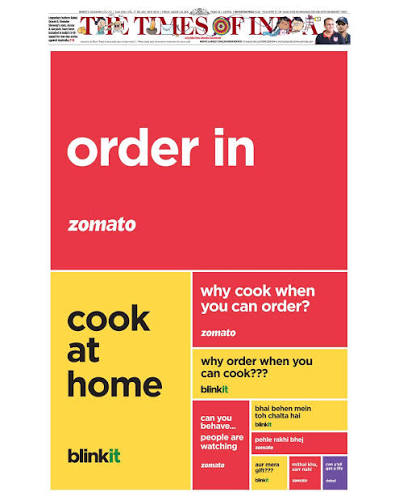
Why it worked: everyone already knows the two apps share a parent company, so the ad turns a possible conflict of interest into a joke instead of hiding it. And since the "rivals" are on the same side, nobody gets hurt.
Case Study: Pepsi's Halloween dig at Coke
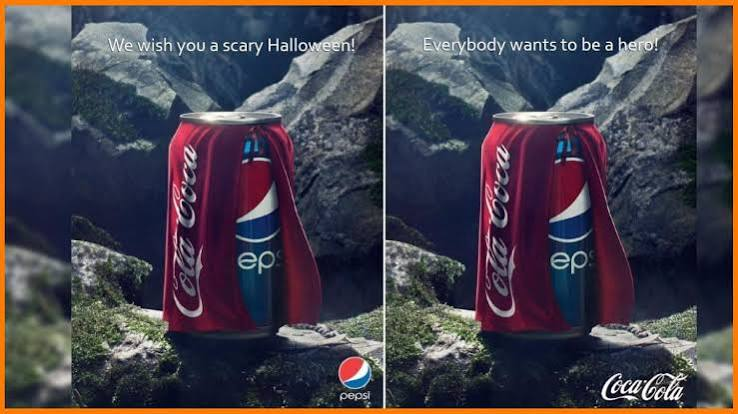
For Halloween 2013, Pepsi's Belgian agency put out an image of a Pepsi can wearing a red cape with "Cola Coca" on it. The caption wished everyone a scary Halloween, which made being Coke the spooky option. Swapping the C and L in the logo kept Pepsi clear of copyright trouble.
The image spread fast on Facebook and Twitter, and then a reply appeared with the same picture and a new caption: "Everybody wants to be a hero!" *6. It didn't come from Coca-Cola or its agencies. It was an unofficial edit that turned the red cape into a superhero's, so the joke became that Pepsi wanted to be Coke.
Source: Food Dive
Why it worked: Pepsi picked a fight with an evenly matched rival and kept it playful, and the audience carried the joke further than either brand did. It's half banter, half crowd. Coke never had to say a word.
Case study: Audi vs BMW, the billboard chess match
Long before brands were quote-tweeting each other, Audi and BMW played chess on billboards. In 2009, Audi put up an A4 billboard in California that dared BMW to make its move. BMW's local dealer answered from across the road with one word, "Checkmate". Audi came back with an R8 billboard saying BMW's pawn was no match for its king, and BMW ended it with a blimp carrying its Formula One car over the billboards and the words "Game over".
There's a twist. Audi told the New York Times that one of its messages had been planned long before BMW's billboard went up, and BMW said it didn't see the exchange as a billboard war at all. The three brands have also met on Facebook. On their Bangladesh pages, Audi joked that a Mercedes G-Class had drawn Audi's four rings on the road, Mercedes fired back, and BMW answered Audi's coffee invite with a relaxed poster that basically told everyone to sit back and watch.
Source: The Branding Journal
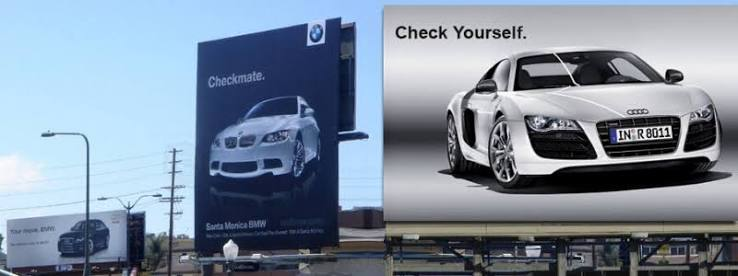
Why it worked: both brands were big, confident and evenly matched, so neither looked like a bully. It also helped that BMW's dealer could reply fast without waiting on head office.
Why is it working right now?
Three things help banter at the moment:
· It travels. A funny exchange between two brands gets screenshotted and reposted far beyond the original audience, so people end up doing the distribution for free.
· It feels live. Replying fast to a rival or a trend shows a brand is paying attention, which a quarterly campaign calendar can't do.
· It gives sameness a face. When products, prices and app interfaces start to look alike, personality is what's left, and a small brand with a sharp social team can sometimes win attention a big budget wouldn't buy.
When it does not work
Punching down is the fastest way to turn a joke into a PR problem. A big brand mocking a smaller player or an ordinary customer rarely ends well. The Branding Journal also points out a quieter risk: a leader swinging at a smaller rival can end up making that rival look like it belongs in the same league.
Copycats are another problem. When everyone reaches for the same meme-fluent voice, it stops sounding like personality and starts sounding like a template.
Finally, a joke can be flipped on you. Food Dive noted that Pepsi's cape could be read as Pepsi wanting to be Coke, which is exactly the angle the fan reply used. And the joke needs something real behind it, like Zomato and Blinkit's family tree, or it's just noise.
Takeaway
Beef and banter works because it feels like a conversation instead of an ad, but the brands that last know where to stop. They pick fights they can have with a straight face, tie the jokes to something real about the product, and stay quiet when a moment isn't theirs. For marketers, the question isn't whether to be funny. It's whether the brand has something worth saying and a voice it can keep up once the joke is over.
Sources
- Swiggy enters the stock market, Zomato shares heartfelt post: https://www.business-standard.com/companies/news/swiggy-enters-the-stock-market-zomato-shares-heartfelt-post-you-and-i-nc-124111300997_1.html
- The benefit of billboard brand rivalry: https://www.thebrandingjournal.com/2015/01/benefit-billboard-brand-rivalry/
- Zomato and Blinkit's hilarious sibling-style ad war asks: Why cook when you can order?: https://www.businesstoday.in/latest/corporate/story/zomato-and-blinkits-hilarious-sibling-style-ad-war-asks-why-cook-when-you-can-order-551975-2026-08-28
- Zomato and Blinkit: A Billboard-Bollywood Collab: https://www.businesstoday.in/visualstories/corporates/zomato-and-blinkit-a-billboard-bollywood-collab-16987-03-01-2023
- Is Zomato inviting you to its wedding?: https://www.afaqs.com/news/advertising/is-zomato-inviting-you-to-its-wedding
- Coke fan's Halloween response to Pepsi ad goes viral: https://www.fooddive.com/news/coke-fans-halloween-response-to-pepsi-ad-goes-viral/190208/
- When Audi and BMW Went Head to Head in Billboard Battle: https://audiworld.com/how-tos/slideshows/when-audi-and-bmw-went-head-to-head-in-billboard-battle-913428
- This Audi, Mercedes, BMW Banter on Facebook Is Delightful: https://www.motor1.com/news/752375/audi-mercedes-banter-facebook/
Image Sources
https://www.businesstoday.in/latest/corporate/story/zomato-and-blinkits-hilarious-sibling-style-ad-war-asks-why-cook-when-you-can-order-551975-2026-08-28
https://www.fooddive.com/news/coke-fans-halloween-response-to-pepsi-ad-goes-viral/190208/
https://www.thebrandingjournal.com/2015/01/benefit-billboard-brand-rivalry/