
BLOGS
Brand India in Defence: How India Is Building Its Image as a Global Defence Power
How defence manufacturing, exports, and public communication are shaping India’s global image.
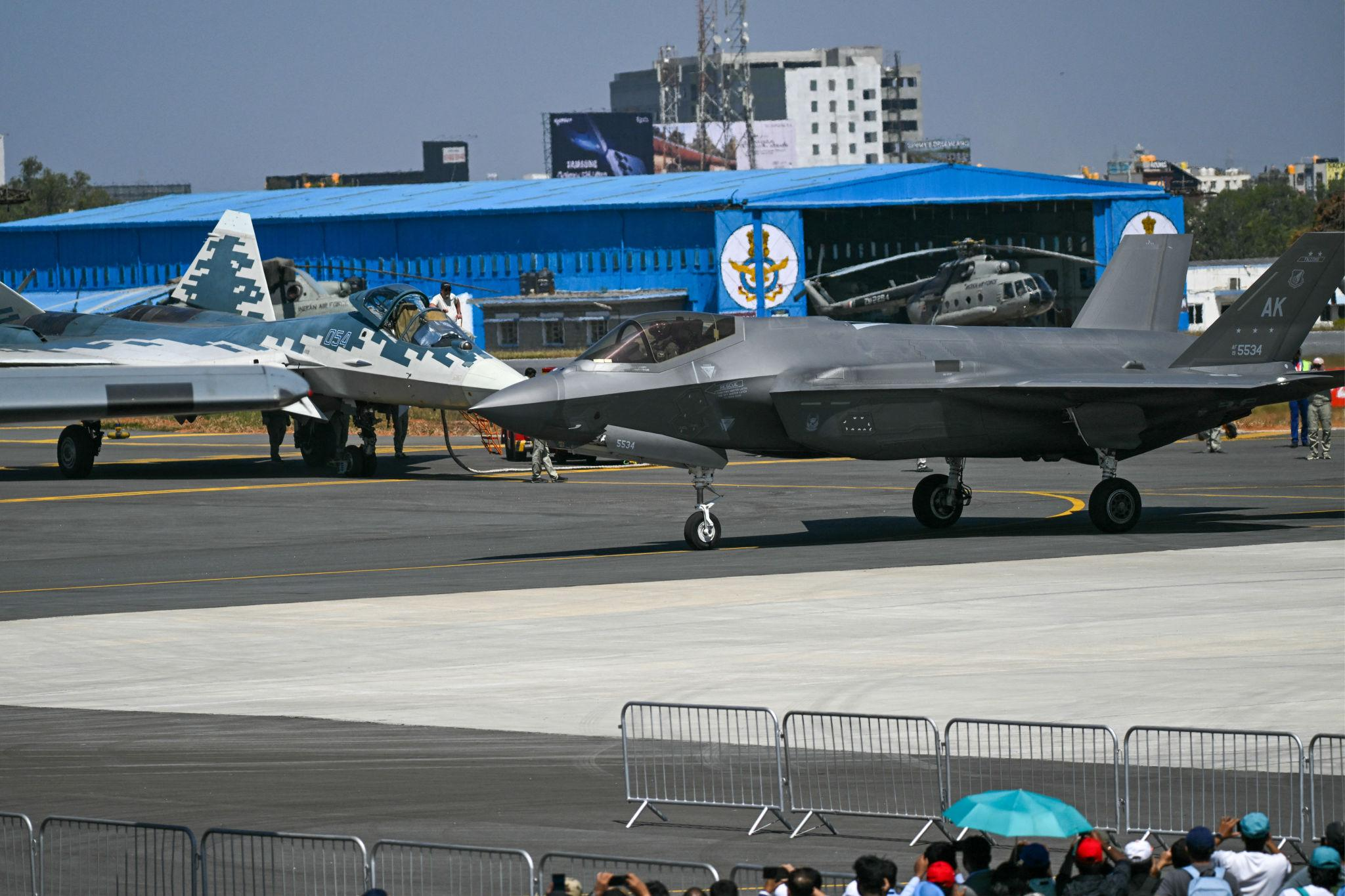
Su-57 and F-35 at the Aero India 2025 static display, Yelahanka Air Force Station, Bengaluru.
Image credit: India Strategic / PIB Photo Division.
The last four decades have been instrumental in India's transformational journey towards becoming a self-reliant defence power. From sanctioning LCA Tejas for the first time in 1983, to the induction of the first batch of LCA Tejas in 2016, India has positioned itself as a nation that can look after its own defence.
From Buyer to Brand
Historically, India has had to rely on imports for its security. But today, through a combination of policy, product and public diplomacy, India is running what is effectively a nation-branding campaign, one that treats missiles, fighter jets and helicopters the way an FMCG company treats a product portfolio. This is nation branding in its purest form: a country deliberately curating how its capabilities, values and reliability are perceived by external buyers, much like a corporation manages its brand across markets. The numbers make the shift concrete. India's defence exports have grown from a mere ₹686 crore in 2013-14 to a record ₹38,424 crore in 2025-26, a jump of over 5,500% in roughly a decade, with Indian-made military hardware now reaching more than 80 countries. This isn't organic growth; it's a deliberately engineered brand transition, and three case studies show exactly how the machinery works: BrahMos, Aero India, and Make in India, tied together by one connecting thread: defence diplomacy.
BrahMos: The Product That Became a Diplomatic Instrument
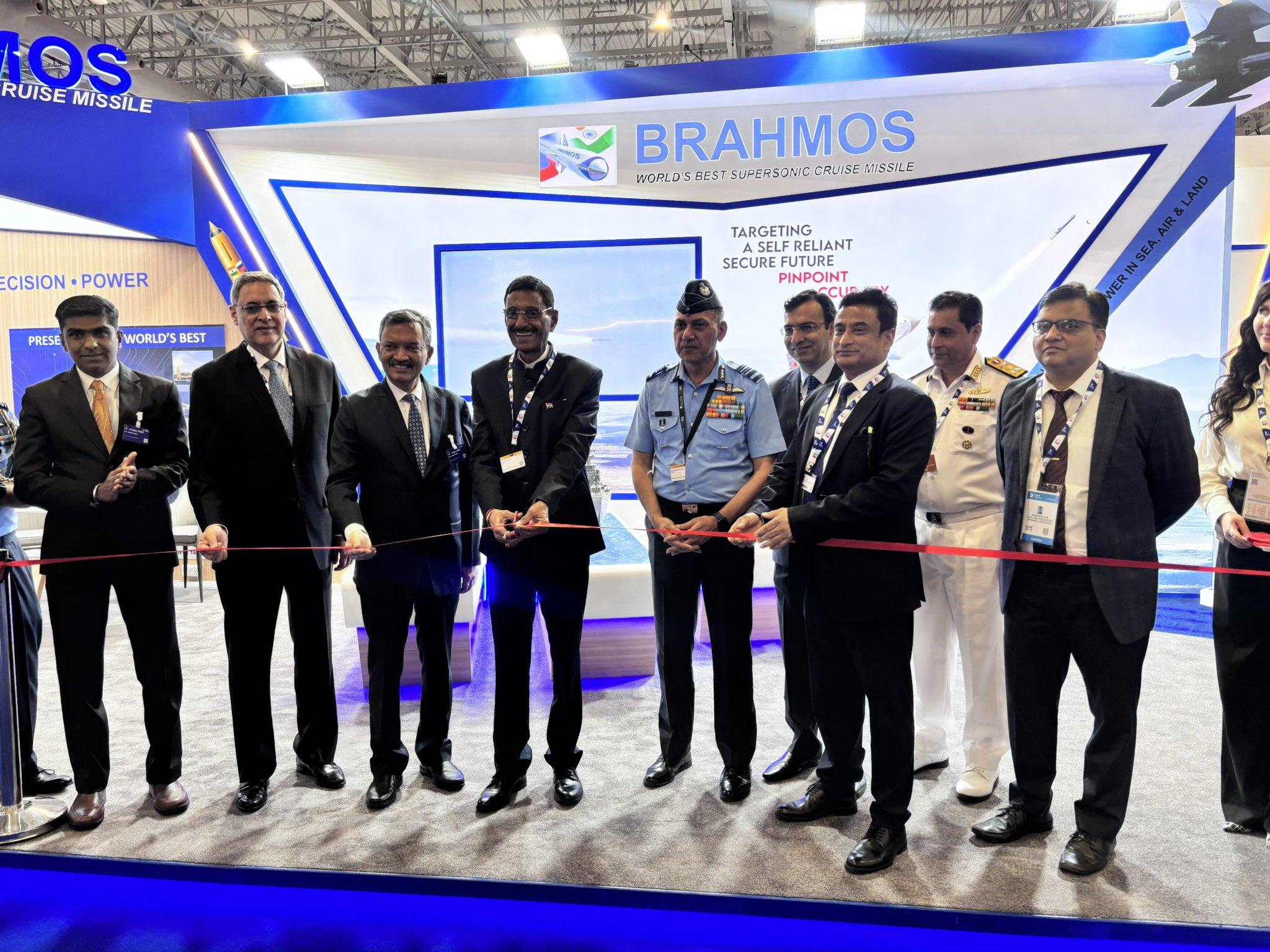
Foreign delegations interact at the BrahMos Aerospace pavilion during Aero India 2025.
Image credit: BrahMos Aerospace Media Center (brahmos.com).
In January 2022, the Philippines signed a $375 million contract for three BrahMos shore-based anti-ship missile batteries, India's first major defence export win. What makes this case study interesting from a marketing lens isn't the missile itself; it's the sequencing of the relationship it built. The first battery was airlifted in April 2024, the second shipped by sea in April 2025, and the third followed by September 2025, each delivery accompanied by visible diplomatic choreography: joint naval patrols, a state visit, a Strategic Partnership declaration, and bilateral trade climbing to $3.9 billion.
This is the core insight for marketers: BrahMos wasn't sold as a transaction, it was sold as a relationship, with each delivery milestone doubling as a media moment reinforcing India's reliability. Notably, BrahMos is a joint India-Russia product, yet it is marketed and received almost entirely as an Indian achievement, a striking demonstration of the country-of-origin effect, where "Made in India" now signals precision engineering and dependability strongly enough to anchor a buyer's threat-deterrence strategy. Other Southeast Asian nations (Vietnam, Indonesia) and Gulf states are now in the pipeline, precisely because the Philippines deal functioned as a public case study, not a private sale. In B2B terms, BrahMos operated as a reference customer whose success story did the selling for every subsequent prospect, a textbook illustration of how trust, once demonstrated publicly, compounds into pipeline.
Aero India: The Trade Show as Brand Theatre
Aero India 2025, held in Bengaluru under the theme "The Runway to a Billion Opportunities," drew participation from over 90 countries, 900+ exhibitors, and generated technology-transfer ambitions upwards of ₹75,000 crore. The event deliberately staged India's ambition on a global runway, literally parking the Russian Su-57 and American F-35 on opposite ends of the same static display, a juxtaposition that let India position itself as the neutral convener rather than a client of either bloc. This is brand positioning at a geopolitical scale: India isn't trying to out-spec the US or Russia on any single platform; it is claiming the distinct territory of "trusted, non-aligned manufacturing partner", a position no other major arms exporter can credibly occupy.
This is also a masterclass in B2B trade-show marketing: Aero India isn't selling one product, it's building category credibility for "Indian defence manufacturing" as a whole, the same way a SaaS platform hosts a flagship conference to legitimize an entire product category rather than a single feature. The CEO Roundtable format (OEMs from 19 countries, 35 Indian private firms, 16 DPSUs in one room) mirrors an ABM tactic scaled to nation level: instead of targeting one account, India is running simultaneous account-based diplomacy on 90 delegations at once.
Make in India: The Master Brand Behind the Portfolio
Underneath both case studies sits Make in India or Aatmanirbhar Bharat, the master brand that gives every missile sale and every airshow a consistent narrative frame. Indigenous defence production has risen from ₹46,429 crore in 2014-15 to ₹1.78 lakh crore in 2025-26, and the private sector, including start-ups and MSMEs, now contributes 45.16% of total exports. Crucially, Defence Public Sector Undertakings' share of exports jumped from 35.5% to 54.5% in a single year, signalling that the state itself is now marketing its own manufacturing base as export-ready, not just import-substituting. Every repeat delivery, every fulfilled contract timeline, and every successful roundtable adds a small deposit to India's brand equity in defence, the accumulated premium of trust that now lets Indian firms compete on reliability and price even when they can't yet match the most advanced Western or Russian platforms on raw capability.
The Connecting Thread: Defence Diplomacy as Brand Strategy
What ties BrahMos, Aero India, and Make in India together isn't just sequencing, it's that each layer performs a distinct brand function. BrahMos builds trust through demonstrated delivery and country-of-origin credibility; Aero India builds category legitimacy and positioning through theatre and convening power; Make in India provides the master narrative that compounds into durable brand equity, making every individual sale feel like part of a larger, credible story. Together, they function exactly like a well-run B2B go-to-market motion: reference customer, industry event, and corporate brand story, reinforcing each other in a loop.
The takeaway for marketers: in high-stakes, low-frequency B2B categories, where a single sale can take a decade and trust cannot be bought with an ad campaign, brand is built through demonstrated reliability made public, not through claims. India's defence sector didn't advertise its way into credibility; it delivered, then let the delivery become the story.
References:
Defence exports & production figures (₹686 cr → ₹38,424 cr, DPSU/private share, production growth):
- PIB / Ministry of Defence Annual Report FY 2025-26 factsheet https://www.pib.gov.in/PressReleasePage.aspx?PRID=2273854®=3&lang=1
- "India's Defence Exports Hit Record Rs 38,424 Crore" https://www.newkerala.com/news/a/driven-defence-sector-reforms-india-makes-mark-as-904.htm
- "India's Defence Exports Hit Record Rs 38,424 Crore" (FICCI session, DPSU/private split) https://bharatshakti.in/indias-defence-exports-hit-record-rs-38424-crore/
- "India's Defence Production Crosses Rs 1.09 Lakh Cr in Q3 of FY26" (838 industrial licences, DPSU share 35.5%→54.5%) https://bharatshakti.in/indias-defence-production-crosses-rs-1-09-lakh-cr-in-q3-of-fy26-exports-hit-record-rs-38424-cr/
- "India's Defence Exports Leap Over 5,500%..." — https://www.indiandefensenews.in/2026/08/indias-defence-exports-leap-over-5500.html
- Explained: India's Defence Exports in FY 2025–26 (₹23,622 cr FY25 baseline) https://abclive.in/2026/04/03/india-defence-exports-2025-26/
BrahMos–Philippines deal (timeline, value, diplomacy):
- "India's Defence Export Diplomacy: Implementing the India–Philippines BrahMos Missile Agreement (2024–2026)" https://www.impriindia.com/insights/policy-update/indias-defence-export-diplomacy-implementing-the-india-philippines-brahmos-missile-agreement-2024-2026/
- "India–Philippines Strategic Partnership (2025–2026): BrahMos, Maritime Cooperation, And The South China Sea" https://www.impriindia.com/insights/policy-update/india-philippines-strategic-partnership-2025-2026-brahmos-maritime-cooperation-and-the-south-china-sea/
- BrahMos Aerospace official press release / media center https://www.brahmos.com/press-release/227
- "India exports second batch BrahMos missile to Philippines via sea", Business Standard, https://www.business-standard.com/external-affairs-defence-security/news/india-brahmos-second-batch-missile-export-philippines-defence-deal-125042100638_1.html
- "India to deliver BrahMos missiles to Philippines later this week" , BusinessLine/PressReader, https://www.pressreader.com/india/businessline-kolkata-9WVY/20240419/282063397015545
- "India inks deal with Philippines to supply BrahMos missiles", Deccan Herald, https://www.deccanherald.com/national/india-inks-deal-with-philippines-to-supply-brahmos-missiles-1075531.html
Aero India 2025 (participation, exhibitors, MoUs, tech-transfer value):
- "Aero India 2025: Empowering Indigenous Aerospace Industry", MP-IDSA, https://idsa.in/publisher/comments/aero-india-2025-empowering-indigenous-aerospace-industry
- "Aero India 2025 Wraps Up", India Strategic, https://www.indiastrategic.in/aero-india-2025-wraps-up/
- "Aero India 2025: India's Largest Defence Expo Begins", Adda247, https://currentaffairs.adda247.com/aero-india-2025-indias-largest-defence-expo-begins/
- "Aero India 2025 aims to have technology transfer above Rs 75,000 crore", Deccan Herald, https://www.deccanherald.com/india/karnataka/bengaluru/aero-india-2025-aims-to-have-technology-transfer-above-rs-75000-crore-says-defence-ministry-3343662
Image Sources: https://www.gettyimages.ie/editorial-images/news/event/day-two-of-the-aero-india-air-show/775303106
https://commons.wikimedia.org/wiki/File%3AF-35_%26_Su-57_Aero_India_2025.jpg?utm_source