BLOGS
Marketing in the Age of AI: Are Brands Losing the Human Touch?
Where AI helps marketers—and what brands risk losing when the human voice disappears.
AI can generate the ad, personalize the offer, answer the customer and even imitate a brand's voice. The harder question is what happens when consumers can no longer tell where the human part begins.
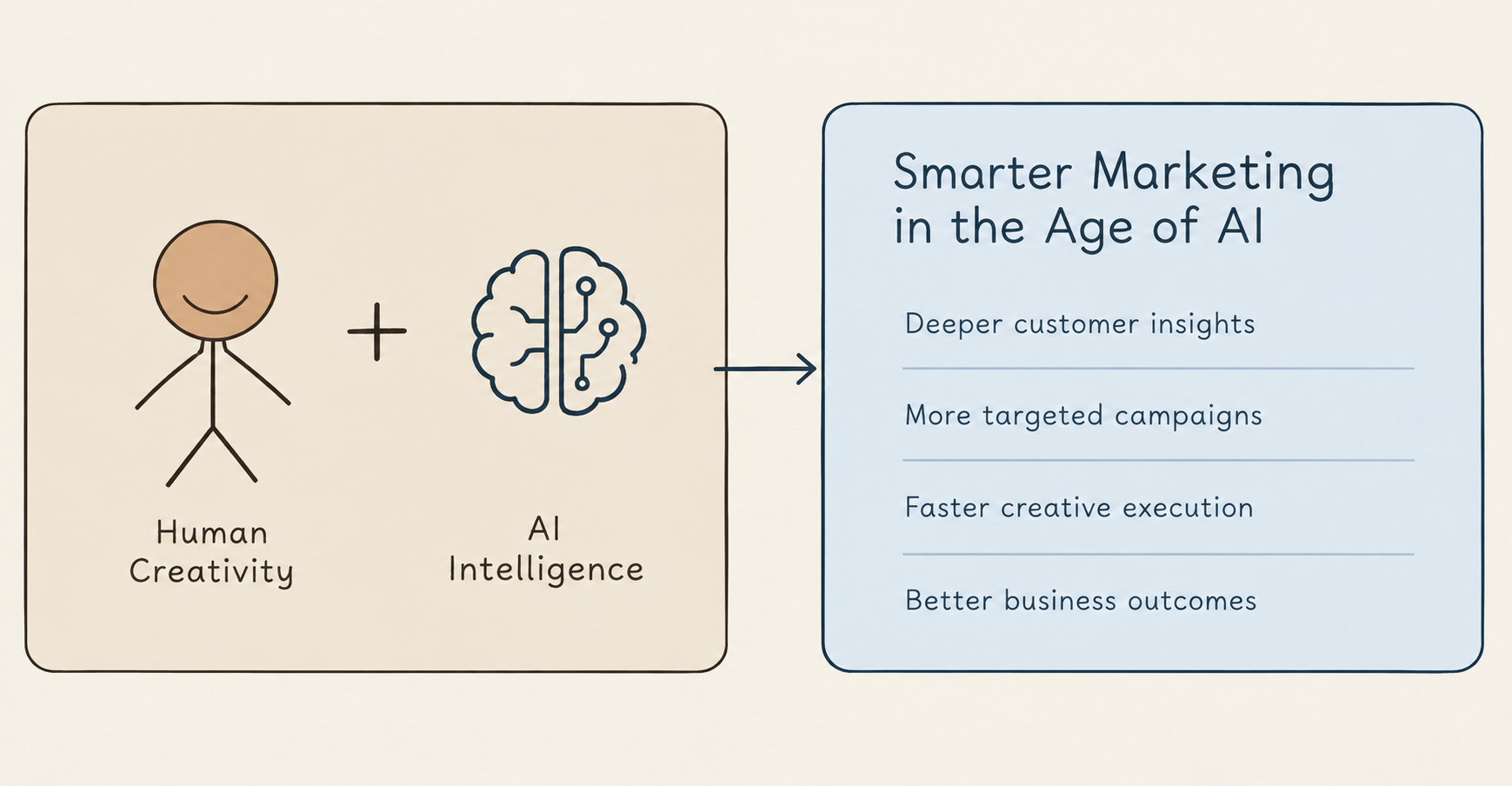
For decades, marketing was built around a recognizably human craft: a copywriter finding the line, a director shaping the emotion, a salesperson reading the room, and a customer deciding whether the brand felt like something they wanted to invite into their life. Artificial intelligence is changing every part of that chain. It can produce thousands of creative variations, predict what a customer might want, summarize feedback, and respond instantly. The efficiency case is already strong. The emotional case is more complicated.
The central tension is not AI versus humans. It is whether brands use AI to make human connection easier, or use it to remove human involvement from places where customers still value judgment, empathy and accountability.
That distinction is becoming important quickly. McKinsey reported in 2025 that 71% of surveyed organizations were regularly using generative AI in at least one business function, with marketing and sales among the functions where adoption was most widespread. At the same time, Gartner reported in 2026 that 50% of surveyed U.S. consumers said they would prefer to do business with brands that do not use GenAI in consumer-facing messages, advertising or content. The technology is spreading faster than consumer comfort is converging.
What is AI marketing?
AI marketing is broader than generating images or writing captions. It includes recommendation engines, predictive models, automated customer service, dynamic creative, audience segmentation, conversational agents, content generation and increasingly, systems that decide which message a person should see and when.
The attraction is obvious: scale. A human team might create a handful of campaign variants. An AI-enabled system can create and test hundreds. A human service agent can handle one
conversation at a time. An AI system can respond to thousands simultaneously. Personalization can move from a segment such as 'young urban consumers' to an individual customer's context.
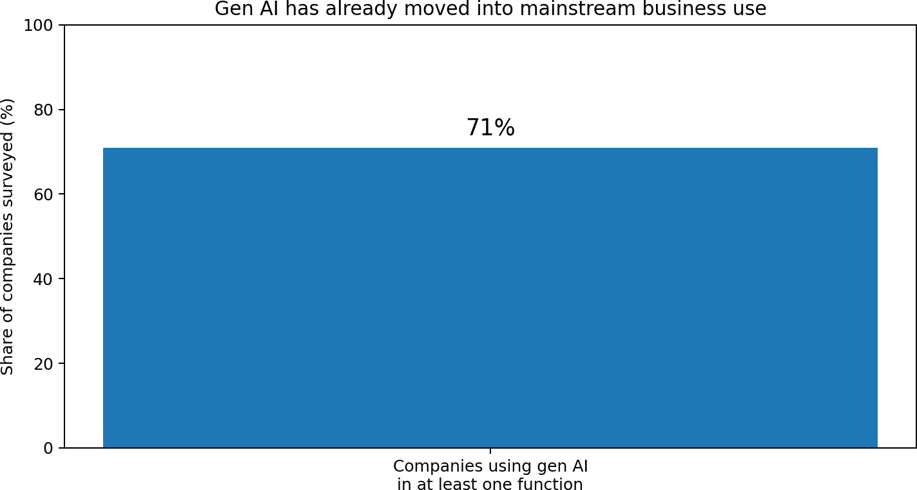
Source : Mckinsey , 2025
The opportunity: AI can make marketing more relevant
AI does solve real marketing problems. It can identify patterns humans would struggle to process at scale, help brands respond faster, and make personalization economically viable. Twilio's 2025 State of Customer Engagement Report, based on 7,640 consumers and 637 business leaders across 18 countries, found that 96% of companies surveyed said AI was improving customer-facing operations such as support, marketing and personalization. Yet only 45% of consumers said they felt understood by the brands they interacted with.
That gap is revealing. A brand can know more about a customer without making that customer feel more understood. Data creates the possibility of relevance, but relevance still has to be translated into a useful, respectful experience.
Case study: Coca-Cola and the two faces of AI creativity
Coca-Cola has been one of the most visible large brands experimenting with generative AI. In March 2023, it launched Create Real Magic, a platform built with OpenAI and Bain & Company that allowed artists and fans in selected markets to create work using Coca-Cola's archival assets with GPT-4 and DALL-E.The company later reported that more than 120,000 pieces of original artwork were generated through the platform.
This is an important model of AI use because the technology did not have to impersonate a human creator. It became a tool for participation. Coca-Cola supplied the cultural raw material, AI supplied a new creative interface, and people supplied the interpretation. The contrast appeared in the brand's 2024 holiday advertising. Coca-Cola released AI-generated versions of its iconic "Holidays Are Coming" concept. The campaign attracted significant criticism from viewers and creative professionals who felt that the new execution lacked some of the warmth and emotional resonance associated with the older human-produced work. Other industry observers noted that the campaign demonstrated the speed and flexibility AI can bring to production
The customer-service test: speed is not the same as care
Customer service is where the human-touch debate becomes tangible. A marketing campaign can be imperfect and still be interesting. A support interaction can be frustrating in a much more immediate way.
Verizon's 2025 CX Annual Insights Report surveyed 5,000 consumers and 500 executives across seven countries. It found that 88% of consumers were satisfied with interactions handled mostly or fully by human agents, compared with 60% for interactions driven by AI
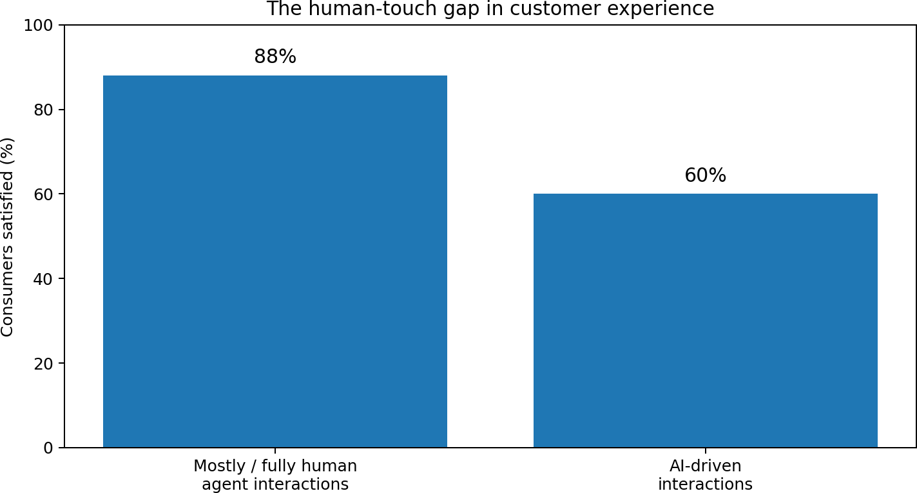
Source: Verizon, 2025 CX Annual Insights Report
The point is not that customers reject automation. In fact, Gartner's 2026 research found that 50% of customers said their interactions were easier when companies used GenAI. But 87% also said that companies using GenAI for customer service should provide an option to reach a human agent.
The emerging expectation is therefore not 'never use AI.' It is 'do not make AI a wall between me and the company.' AI can handle repetitive questions, summarize a customer's history, surface the right information and route complex cases. The human agent can then spend more time on exceptions, emotional situations and decisions that require accountability.
Why trust is becoming the scarce resource
The more synthetic content consumers encounter, the harder it becomes to use polish itself as proof of quality. A perfect image no longer tells us who made it. A convincing voice may not belong to a person. A personalized recommendation may be helpful, but it may also be the result of a system optimizing for a commercial objective the customer cannot see.
Gartner's March 2026 research found that 61% of surveyed U.S. consumers frequently questioned whether information they use for everyday decisions is reliable, while 68% frequently wondered whether the content they saw was real. Gartner's September 2026 research also found that 65% of surveyed U.S. consumers believed brands were producing too much AI-generated marketing content, and 57% said such content had made them less trusting of brand messaging overall.
This creates a strange reversal. AI makes it cheaper to produce content, so the strategic value of producing more content falls. The value shifts toward signals that help people decide what deserves attention and trust: recognizable brand behavior, clear disclosure, credible evidence, real people, useful experiences and consistency between what a brand says and what it does.
What should marketers do?
Automate the repetitive, not the meaningful. Use AI for research, variation, summarization, testing, recommendation and routine support. Protect human time for strategy, judgment, creative direction and difficult customer situations.
Make AI visible when it changes the experience. Consumers increasingly want to know when they are interacting with AI. Clear disclosure can reduce the feeling that a brand is hiding the mechanism behind the interaction.
Give customers an exit to a human. For high-stakes or emotionally complex interactions, the ability to reach a person should be part of the experience rather than an escalation path hidden behind endless automation.
Use AI to personalize, not to manipulate. The difference is whether the customer gets a genuinely useful outcome. Personalization that saves time or improves relevance can create value.
Personalization that feels invasive can destroy it.
Build a recognizable human point of view. If AI makes production abundant, brand meaning becomes more dependent on choices that cannot be reduced to output volume: what the brand believes, what it refuses to do, and what it sounds like when everyone has access to the same tools.
Takeaway
AI is not making the human touch irrelevant. It is making the human touch easier to notice.
When everyone can generate an image, the image is less scarce. When everyone can generate a copy , copy is less scarce. When every brand can personalize at scale, personalization itself becomes less distinctive. What remains scarce is judgment: knowing what to say, what not to say, when automation is appropriate, when a customer needs a person, and what kind of relationship the brand actually wants to build.
The strongest marketing model in the AI age may therefore be neither fully automated nor nostalgically human. It is deliberately mixed. Let machines handle scale, pattern recognition and repetition. Let people handle meaning, accountability, empathy and the final creative choice. The question for brands is no longer whether they can make marketing faster. AI has largely answered that. The harder question is whether they can make it feel more worth believing.
Sources and References
[1] McKinsey & Company. “Gen AI's broad reach.” 17 April 2025. https://www.mckinsey.com/featured-insights/charts/gen-ais-broad-reach
[2] Gartner. “Marketing Survey Finds 50% of Consumers Prefer Brands That Avoid Using GenAI in Consumer-Facing Content.” 16 March 2026. https://www.gartner.com/en/newsroom/press-releases/2026-03-16-gartner-marketing-survey-finds-50-percent-of-consu mers-prefer-brands-that-avoid-using-genai-in-consumer-facing-content0
[3] Twilio. “AI Alone Won't Cut It: Twilio's 6th Annual Report Finds Trust and Timing Drive Customer Loyalty.” 3 June 2025. https://www.twilio.com/en-us/press/releases/socer-2025
[4] The Coca-Cola Company. “Coca-Cola Invites Digital Artists to ‘Create Real Magic’ Using New AI Platform.” 20 March 2023. https://www.coca-colacompany.com/media-center/coca-cola-invites-digital-artists-to-create-real-magic-using-new-ai-platform
[5] The Coca-Cola Company. “Coca-Cola Harnesses Power of AI to Deliver Holiday Magic.” 27 November 2023. https://www.coca-colacompany.com/media-center/coca-cola-harnesses-power-of-ai-to-deliver-holiday-magic
[6] Marketing Interactive. “Why are consumers upset with Coca-Cola's AI-generated remake of its holiday ad?” 19 November 2024. https://www.marketing-interactive.com/coca-cola-ai-remake-holiday-ad-mixed-sentiments
[7] Marketing Brew. “Inside the making of one of Coca-Cola's controversial holiday commercials.” 21 November 2024. https://www.marketingbrew.com/stories/2024/11/21/inside-the-making-of-one-of-coca-cola-s-controversial-holiday-commercials
[8] Dove. “Keep Beauty Real: Beauty in the AI age / The Code.” https://www.dove.com/us/en/campaigns/purpose/keep-beauty-real.html
[9] Verizon. “AI and the Empathy Gap: Finding the Balance between AI and Human First Customer Experience.” 13 August 2025. https://www.verizon.com/about/news/feed/ai-and-human-first-customer-experience
[10] Gartner. “Survey Finds 87% of Customers Say Companies Using GenAI for Customer Service Must Provide Access to a Human Agent.” 4 August 2026. https://www.gartner.com/en/newsroom/press-releases/2026-08-04-gartner-survey-finds-87-percent-of-customers-say-companies-using-genai-for-customer-service-must-provide-access-to-a-human-agent0
[11] Gartner. “Marketing Survey Finds 35% of Consumers Rely on Influencers Less Due to AI.” 22 September 2026. https://www.gart ner.com/en/newsroom/press-releases/2026-09-22-gartner-marketing-survuey-finds-35-percent-of-consumers-rely-on-influencers-les s-due-to-ai
[12] PwC. “2025 Customer Experience Survey.” 29 September 2025. https://www.pwc.com/us/en/services/consulting/commercial-excellence/library/2025-customer-experience-survey.html