
CASE STUDIES
AMUL: THE ART OF STAYING RELEVANT
How the Amul Girl and topical advertising have kept a familiar brand part of public conversation.
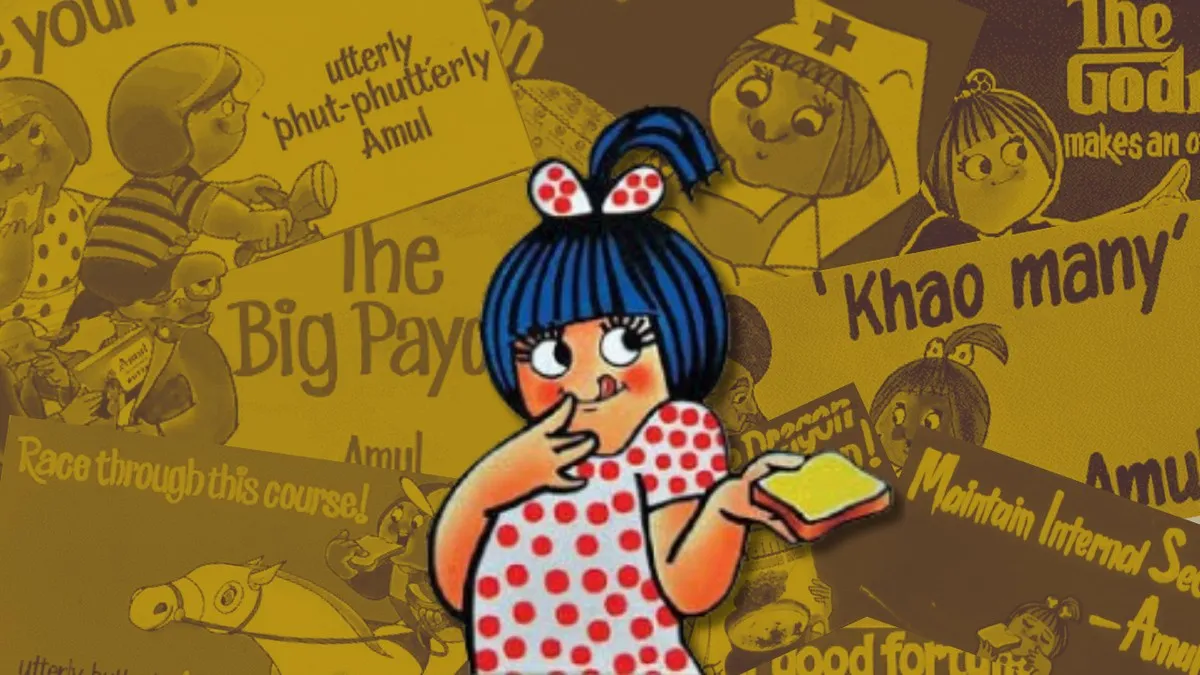
Source: Financial Express
In 1966, a butter brand with almost no money hired an ad man who decided to comment on the news. Sixty years on, the same cartoon girl is still on the hoardings. This is the story of how a small cooperative built a legacy out of a character and a habit, and of what it takes to stay relevant once the legacy is built.
Amul began as a farmers' cooperative in Anand, Gujarat, led by Dr Verghese Kurien, the man behind India's White Revolution. Its first big consumer product was butter, launched in 1945, and by the mid-1960s the brand had what its own agency later called a staid, boring image.4
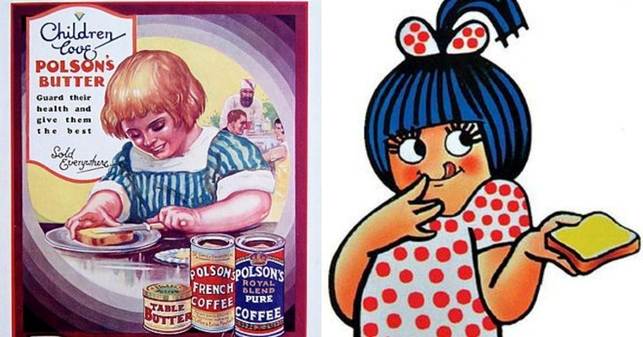
Across the shelf sat Polson, a dairy brand that had dominated Indian butter for decades. The name had become almost a generic word for the product, and Polson even had a mascot: a soft, well-mannered blonde girl buttering her toast.2 Customers used to Polson's taste also had to be persuaded to switch to Amul's, which reportedly tasted different at first.2
Amul had the product, the farmers and almost no advertising money. R.S. Sodhi, who later ran the federation, put the problem plainly: the question was how to establish the brand with minimum money.3 That limit shaped everything that followed.
The Idea That Was Not in the Brief
In 1966 Sylvester daCunha won the Amul account for his agency, ASP. He and art director Eustace Fernandez decided they needed a girl who would "worm her way into a housewife's heart". A little girl, aimed straight at Polson's, was the obvious answer. Theirs was a mischievous one, with blue hair and a polka-dot frock, where Polson's had been well behaved.2, 4
The idea that made her famous came a little later. In March 1966 a hand-painted hoarding played on Mumbai's Derby with the line "Thoroughbread", and people noticed.4 According to his son Rahul, who now runs the account, Sylvester realised that these topical ads were exactly what caught people's fancy.4 The commentary had not been planned. It was spotted, and then built into the strategy.
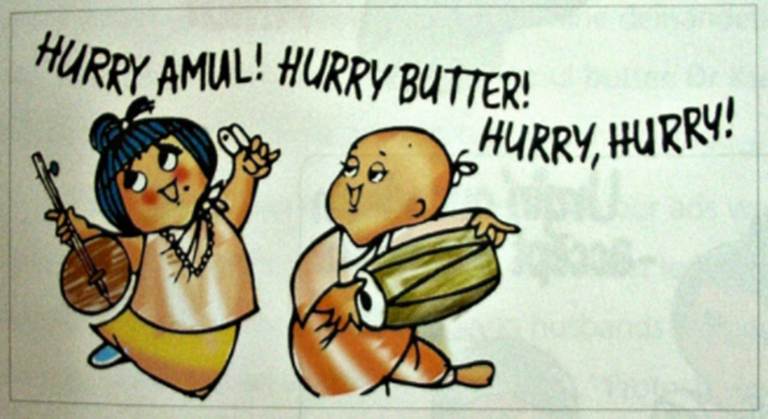
The early topicals show the pattern. A monsoon ad ran "Pitter-patter, pick-a, pack-a Amul butter". When Kolkata was hit by hartals in the 1960s, the hoarding read "Bread without Amul, cholbe na, cholbe na", borrowing the processions' cry of "cholbe na" (will not do), and it drew smiles from Bengalis across the country. By one account, it was with "Hurry Amul, Hurry Hurry", at the height of the Hare Krishna movement, that Sylvester saw the power of a topical zing.13 The format also set a rule: a topical had to go up quickly or it lost most of its impact.13
From then on, the hoardings stopped talking about butter and started talking about India: a film, a strike, a budget. The butter turned up at the end. The insight was that people were already paying attention to the news, so a brand that sat inside the news would be read instead of skipped.
Building a Machine Around One Girl
A good idea is not the same as a legacy. What turned the topical into one was discipline, and the discipline is the part of the story most brands miss.
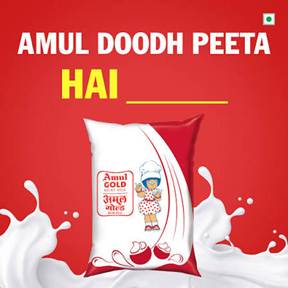
The girl, the line "Utterly Butterly Delicious Amul" and the hoarding format barely changed. Sodhi said Amul followed the same rule everywhere: once a campaign is created, it is adhered to, and brand building is consistent in communication over a long period.6 The same logic ran through taglines such as "Amul - The Taste of India" and "Amul Doodh Peeta Hai India".
Consistency is what made speed possible. The cadence moved from about one topical a month to five a week by 2017, and by 2019 Rahul daCunha described a topic almost every day. A small team meets each Monday to choose the week's topics. The illustrator sketches three or four options and hand-paints the final one, and a response to a breaking story can be out in under two hours.5 That speed is possible only because the character, voice and format are fixed. Each new ad needs one fresh joke, not a new campaign.
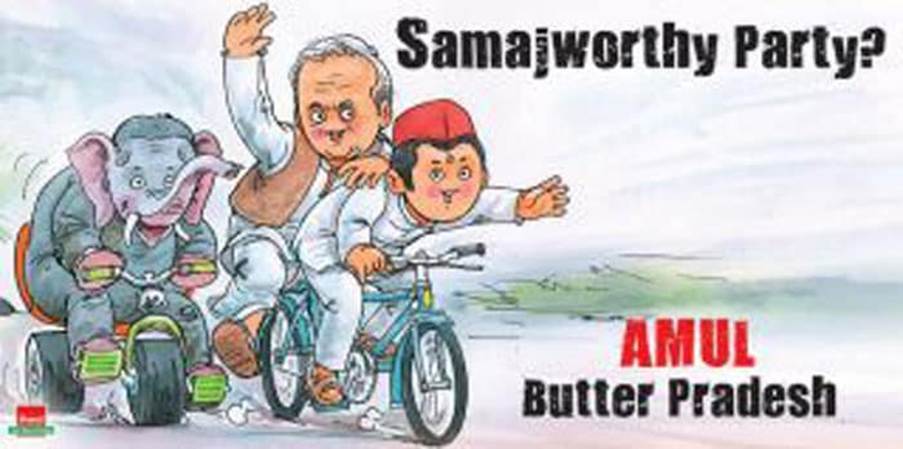
The payoff shows in who notices. When Amul asked "Samajworthy Party?" during the 2012 Uttar Pradesh election, Akhilesh Yadav reportedly cut out the ad and pinned it to his notice board. When the Girl joked about the artist M.F. Husain in "Heroine Addiction", he asked for a copy.5, 13 Brands rarely get their targets to frame the joke.
Speed also needed trust. Sodhi said the same agency has made the campaign for fifty years and does not show Amul the creative. Rahul recalls that sending ads for approval would simply not work.5, 6 The client gave up control so the ads could stay timely.
The economics fit. Amul sells everything under one name, which Sodhi called umbrella branding, so one campaign serves the whole portfolio. He said advertising stayed below 1% of turnover, and at or under 0.8% for the five years to 2019.6 Outdoor sites cost little, and the rest was earned: when an ad becomes the headline, the newspapers carry it for free. The campaign is credited with a Guinness World Record for the longest-running outdoor ad campaign.6
Exhibit 2. A selection of Amul topicals
Amul Topical | Event |
|---|---|
Thoroughbread | The Girl as a jockey during Mumbai's Derby season; the first topical. |
Bread without Amul, cholbe na, cholbe na | Kolkata hartals in the 1960s, playing on the processions' slogan. |
Indian Airlines Won't Fly Without Amul | An Indian Airlines strike; the airline reportedly threatened to stop serving Amul butter |
Heroine Addiction | A joke on the artist M.F. Husain, who asked for a copy. |
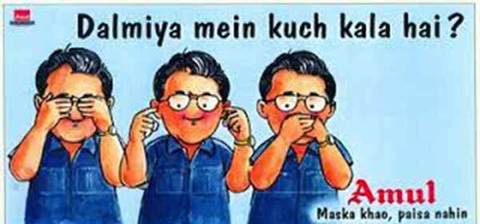
Dalmiya mein kuch kala hai? | Suspicions about BCCI chief Jagmohan Dalmiya, who threatened to sue. |
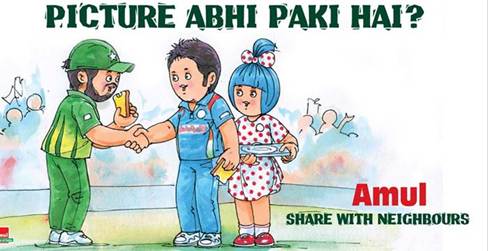
Share with neighbours | An Indian and a Pakistani cricketer shaking hands, each holding buttered bread; the billboard was up the next day |
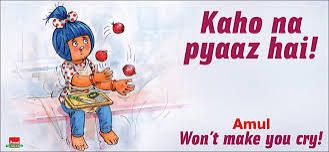
Kaho Na Pyaz Hai | The Girl juggling three onions during an onion price spike |
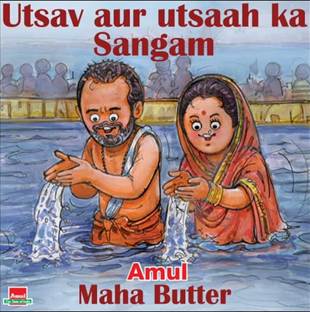
Utsav aur utsaah ka Sangam, Amul -Maha Butter | The Maha Kumbh Mela |
The Problem of Staying Young
By the 2010s the legacy itself had become the risk. A brand carried by a character from 1966 can end up as a heritage brand, loved but not chosen. Amul's answer was to let the Girl keep moving. She has appeared as film stars such as Madhuri and Urmila, and sometimes simply as herself.12 At the same time the company changed the mix around her. In 2019 Sodhi explained a World Cup sponsorship of the Afghanistan cricket team as a way to connect with youth.6
The examples show how she keeps up. During an onion price spike she juggled three onions under the headline "Kaho Na Pyaz Hai", a parody of a Bollywood title. In 2025 she appeared at the Maha Kumbh Mela with "Amul – Maha Butter".13
The scale of what the Girl now has to carry is large. In FY26 the Gujarat Co-operative Milk Marketing Federation (GCMMF), which sells under the Amul name, reported sales of ₹73,450 crore, up 11.4%. Brand turnover, which adds the sales of 18 member unions, passed ₹1 lakh crore. Amul sells over 1,200 product packs and operates in more than 50 countries.1 A mascot born to sell butter now stands over ice cream, flavoured milk, protein and exports.
Brand Finance's 2026 ranking suggests the relevance has held. It scored Amul 93 out of 100 on brand strength, the highest among dairy brands, ahead of Vinamilk (89.6) and Valio (88.3). Amul was already the strongest dairy brand in 2024.8, 9 Its brand value rose 22% to $5 billion, which puts it fourth: China's Yili is far bigger at $14.5 billion.8 Amul is the strongest dairy brand in the world, though not yet the biggest.
Where the Magic Stops
The same boldness has cost Amul at times. The Girl's topicals are live commentary, and live commentary carries live risk. When Amul ran ads about an Indian Airlines strike, the airline reportedly threatened to stop serving Amul butter on its flights, and an ad showing the Girl in a Gandhi cap drew protests.11
Other topicals drew legal threats. "Dalmiya mein kuch kala hai?", about suspicions over the then BCCI chief Jagmohan Dalmiya, led him to threaten a defamation suit. After "Satyam Sharam Scandalum!" on Ramalinga Raju, the Satyam board reportedly wrote threatening consequences.11, 13
A bigger limit came in 2023, when Amul announced online delivery of milk and curd in Bengaluru. Within days #GoBackAmul and #SaveNandini were trending. Nandini, the Karnataka Milk Federation's brand, held around 70% of the city's milk and sold at about ₹39 a litre against Amul's roughly ₹54 online. A state election a month away turned a retail launch into a matter of regional pride.10 Amul's managing director called it a calibrated entry for a niche segment.
The Girl was not the problem. The lesson is that brand strength built over decades in one set of markets does not automatically travel into one where a local cooperative already owns the trust and the price.
What Built the Legacy, and What Keeps It Relevant
Looked at as one story, the legacy rests on a short chain. A constraint, no money, pushed Amul to choose a medium where wit could stand in for frequency. A discovery, that news commentary caught people's fancy, gave it an idea. And discipline, one girl, one voice and one format, held for sixty years, turned the idea into recognition that compounds.
The cooperative structure explains part of the patience. A farmer-owned story gives trust that an ordinary FMCG company has to buy. With no investors pushing for quarterly growth, Amul could hold one mascot for six decades and give the agency creative freedom.
Relevance, by contrast, has come from refusing to let the mascot be the whole strategy. The Girl keeps Amul culturally current. Protein pricing, ice cream and sport sponsorships keep it commercially current.
References
1. Amul reports turnover of US$12B in FY 2025/2026
https://dairybusinessmea.com/2026/04/09/amul-reports-turnover-of-us12b-in-fy-2025-2026/
2. The 'Amul' Of Our Grandparents, And The Butter Wars That Took The Brand Down
3. What are Amul Topicals how did they create a legacy?
4. If you want to succeed as a food brand in India, think regional first
5. The Little Girl Who Refuses to Age
https://openthemagazine.com/art-culture/the-little-girl-who-refuses-to-age#google_vignette
6. The Story of the Amul Girl, India's Ad Icon Who Was Ahead of Her Time
7. IMA 2016No ads spends cut post-demonitization: RS Sodhi, Amul
8. Amul-Nandini Row Continues To Keep Karnataka On The Boil
https://odishabytes.com/amul-nandini-row-continues-to-keep-karnataka-on-the-boil/
9. #Save Nandini, #Boycott Amul campaign gains momentum in poll-bound Karnataka
10. Witty, gritty, and sometimes risky: A look back at Amul ads over the years
https://www.socialsamosa.com/samosa-snippets/a-look-back-at-amul-ads-over-the-years-7609993
11. The Little Girl Who Refuses to Age
https://openthemagazine.com/special/the-little-girl-who-refuses-to-age/
12. Amul Topical on onion takes social media by storm
13. Amul Girl dives into Mahakumbh with creative Topical
Image Sources
2. https://www.goodadsmatter.com/post/what-makes-amul-visually-appealing-and-memorable
5. https://en.wikipedia.org/wiki/Amul
6. https://www.ndtv.com/photos/news/amuls-take-on-barack-obamas-four-more-years-10709
7. https://www.afaqs.com/creative-showcase/print/36725-picture-abhi-baki-hai