CASE STUDIES
How Minimalist Built a ₹2,955 Crore Skincare Brand in Four Years
How ingredient transparency, pricing, and direct-to-consumer distribution shaped Minimalist’s growth and its acquisition by HUL.
Introduction
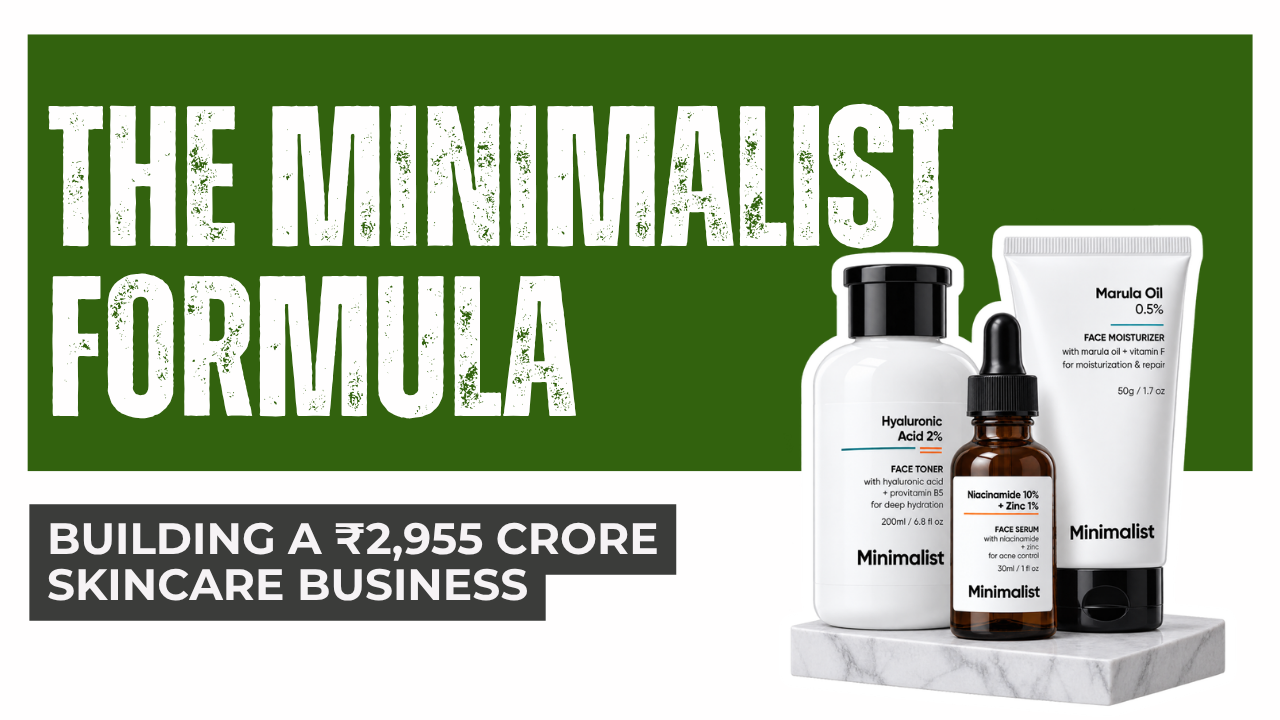
On 22 January 2025, Hindustan Unilever (HUL) told the stock exchanges that it had agreed to buy 90.5% of Uprising Science, the company behind the skincare brand Minimalist, at a pre-money enterprise value of ₹2,955 crore. The brand was barely four years old. It had launched in October 2020 through a single Instagram post on an account with a few hundred followers, with no advertising and no celebrity (Note 1).
The founders, brothers Mohit and Rahul Yadav, were not first-time entrepreneurs, and the brand was not an accident. It was built around one idea: tell Indian shoppers exactly what is in the bottle and how much of it, and price it for India. It entered a market where HUL, L’Oréal and a wave of “natural” brands already competed, and its revenue grew from about ₹21 crore in its first months to ₹347 crore in FY24 while it stayed profitable (Exhibit 4).
This case asks how Minimalist grew so fast without heavy advertising, what that growth depended on, and what the sale to HUL suggests about the limits of an online, transparency-led brand.
Background
The Company
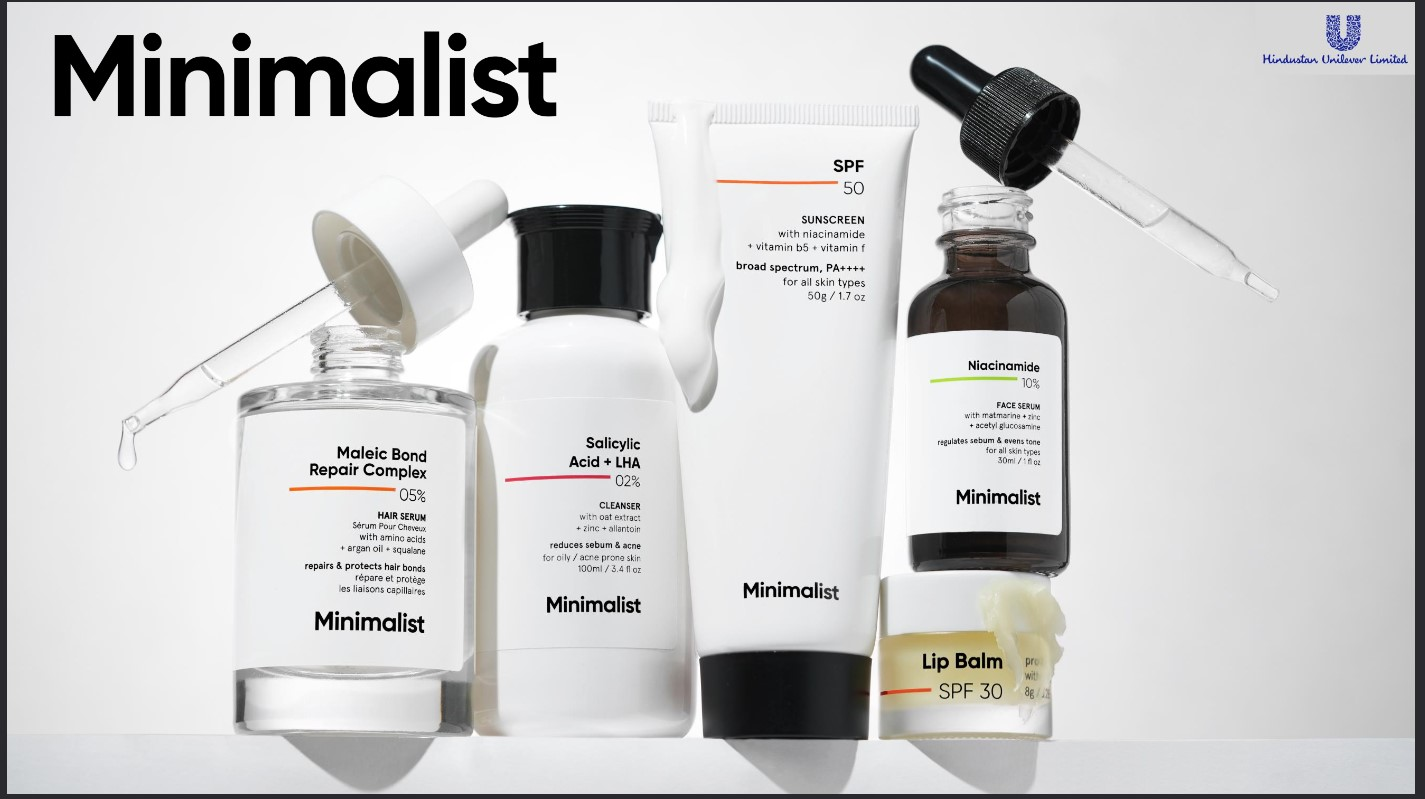
Minimalist is a skin, hair and body care brand from Jaipur, run by Uprising Science Pvt Ltd. It began with face serums, each built around one active ingredient, and later added toners, moisturisers, sunscreens, hair care and baby care. Prices were reported at about ₹300 to ₹700, and by 2024 the range had grown to more than 50 products. The brand makes its products in its own facility in Jaipur instead of using contract manufacturers.
The Founders
Mohit Yadav is a chartered accountant who worked at Credit Suisse. Rahul Yadav is a chemical engineer from IIT Roorkee. In 2008 they started an online T-shirt store that became Mangostreet, a kids’ fashion site, which they sold to Hushbabies in 2012. Both later worked at CarDekho in Jaipur. In 2018 they launched Freewill, a personalised hair care brand that made products to order for each customer’s hair type. Customers liked it, but the made-to-order model was slow and costly to grow, and the brothers shut it down after about two years (Exhibit 2).
The Market
India’s skincare market was worth about US$1.7 billion in 2020 and had grown 13% to 15% a year over the previous five years. HUL (Lakmé, Ponds) and L’Oréal (Garnier, L’Oréal Paris) led it (Exhibit 1). The pandemic pushed shoppers online. They spent more time on skincare and on Instagram and YouTube, where creators were explaining ingredients, and platforms such as Nykaa and Amazon let them compare reviews and ingredient lists before buying.
The Gap the Founders Saw
Mohit Yadav has said that regulations do not require a minimum amount of an ingredient for a brand to make a claim about it. A product called “brightening” could contain a trace of vitamin C, and so could one with a level that actually works (Note 2). At the same time, many brands sold “natural” and “chemical free” stories, with the ingredient list in small print at the back. The Ordinary, a Canadian brand known for clear labels, was admired by India’s online skincare community but was expensive here because of import costs.
The opening was therefore not a new product type. It was an ingredient-first, science-based brand at Indian prices.
The Launch
Minimalist launched in October 2020 with one Instagram post to an account of a few hundred followers. The first batch was small, reported at 750 bottles across five products by Forbes India and at 1,000 bottles elsewhere (Note 3). It sold out within days. A skincare creator discovered the brand and spoke well of it, other creators followed, and the account grew quickly (Note 1). For the first two months, the two founders answered emails, messages and comments themselves.
The launch was not free of controversy. Critics pointed out that the labels, design and bottle style looked like The Ordinary’s, and called the brand a copy. Supporters said it gave Indians access to something they could not easily afford. The founders did not deny the inspiration, and the argument itself brought more traffic to the brand.
How Minimalist Competed
Transparency. Labels and web pages showed each ingredient and its concentration, and explained why it was used. The brand also embraced the word “chemical”, arguing that some chemicals were safer and more effective than so-called natural alternatives.
A focused range. The brand started with serums, a format that was not yet crowded, and kept its range under 20 products at first. Each product targeted one concern, such as acne or pigmentation.
Customers as marketing. In its early months the brand avoided paid creators and free PR packages. It reposted customers’ own posts after asking permission, and it teased new ingredients for a couple of weeks before a launch. Mohit Yadav says the brand did only four or five paid partnerships in its first five years (Note 2).
Quality as a choice. The brand set up its own lab. The founder says the first setup was small, mostly leased, and cost about ₹25 to 30 lakh (Note 2). It chose costlier raw materials, and its cost of goods was reported at about 30% to 35% of revenue (Exhibit 6).
Online first. The brand sold through its own website, Amazon and Nykaa, and about 90% of its sales were online by 2024. It kept prices the same across platforms and avoided flash sales.
Growth, 2021 to 2024
By mid-2021, Minimalist was reported to have reached a ₹100 crore annual revenue run rate within about eight months (Note 4). In July 2021 it raised ₹110 crore (about US$15 million) in a Series A round led by Peak XV Partners, then called Sequoia Capital India, with Unilever Ventures also taking part. Revenue reached ₹184 crore in FY23 and ₹347 crore in FY24, and the company reported a profit in each year (Exhibit 4).
Competitors followed, including Foxtale, Deconstruct, Pilgrim and The Derma Co. by Mamaearth. Minimalist kept to its approach, with a repeat purchase rate reported at around 60% and advertising spend reported at about 30% of revenue, against around 40% or more at several rivals (Exhibit 6). It added baby care in June 2024, entered a few international markets and planned its first exclusive stores. The founder says it went offline only after 40 to 50 retailers had asked for the product (Note 2).
The HUL Deal
HUL’s offer, announced on 22 January 2025, valued Minimalist at ₹2,955 crore before the new investment. HUL agreed to pay ₹2,670 crore to existing shareholders and put in ₹45 crore of fresh capital. Before the deal, Peak XV held about 27.9% and the founders about 62%. The deal closed in April 2025 for a total of about ₹2,706 crore. HUL will buy the remaining 9.5% in about two years, and the founders agreed to keep running the business for that period (Exhibit 7). The price is about 8.5 times FY24 revenue (Note 5).
The reasons were reported more than stated. Minimalist had reached the size at which growth in India depends on offline reach, which HUL already had. HUL, whose own D2C brands were reported to run at about ₹100 crore a year, chose to buy rather than build (Forbes India).
Aftermath
In FY25, Minimalist’s revenue rose 48% to about ₹515 crore. Advertising spend was ₹154 crore, and EBITDA stayed positive at about ₹18 crore. The company reported a net loss because of one-time charges linked to the deal (Note 6). In FY26, its first full year under HUL, revenue rose about 36% to about ₹690 crore and the company reported a profit after tax of about ₹26 crore (Exhibit 4).
Key Takeaways
- Look for a trust gap. Minimalist did not invent a new product. It acted on the lack of honest information in an existing category.
- Make education do the work of advertising. Useful explanations were shared by customers and creators without payment, especially in the early months.
- Let quality lower the cost of marketing. Higher cost of goods and R&D were paid for by repeat buying, but they also kept profit margins thin.
- Know when a channel runs out. Online took the brand to a few hundred crore rupees. The next stage needed a partner with offline reach.
Decision Points for Discussion
Positioning. Was transparency a lasting advantage or a head start that rivals could copy? What would make it hard to copy?
Inspiration. The brand was openly modelled on The Ordinary. What separates learning from a global leader from copying it, and how should a brand handle that criticism?
Marketing. Minimalist is described as a low-marketing brand, yet reported advertising spend reached ₹154 crore in FY25. At what point does the label stop being accurate?
Margins. Minimalist chose higher cost of goods to protect quality, and net margins stayed around 3% in FY23 and FY24. Was that the right trade-off?
Channel timing. The brand stayed mostly online until retailers asked for it. When should a D2C brand open an offline channel, and who should lead it?
The sale. Should the founders have sold in January 2025 or stayed independent? What must HUL do to keep the trust the brand built?
Notes
1. Reports differ on how fast the Instagram account grew. A Junior VC says it reached 10,000 followers within two days of launch, while other accounts say within a few weeks to two months.
2. Statements attributed to Mohit Yadav on the legal position of ingredient claims, paid partnerships, the cost of the first manufacturing setup, supplier choice and the timing of offline retail come from a long-form founder interview supplied by the case writer. They have not been matched to a second published source.
3. Forbes India reports a first batch of 750 bottles across five products. Other reports and the founders’ interviews mention 1,000 bottles.
4. The “₹100 crore in eight months” figure is an annual run rate, not revenue earned in eight months. FY22 revenue was about ₹108 crore. FY21 revenue of about ₹21 crore comes from The D2C Pulse only.
5. Case writer’s calculation: ₹2,955 crore ÷ ₹347 crore ≈ 8.5. Profit margins in Exhibit 4 are profit after tax divided by revenue from operations, using the reported figures, and are approximate.
6. Early reports put the FY25 loss at about ₹31.5 crore, with ₹46 crore of exceptional items. The FY26 filing, however, compares against a much larger FY25 loss (₹270.5 crore) and a revenue of ₹506.5 crore, so FY25 figures appear to have been restated. Treat them with caution. Founders’ payout is reported at about ₹1,600 crore (Storyboard18) and elsewhere at about ₹1,700 crore. Advertising spend as a share of revenue also varies by source and year, from about 25% to 35%.
Exhibits
Exhibit 1: The Indian Skincare Market, 2020
Indicator | Figure |
|---|---|
Indian skincare market size, 2020 | about US$1.7 billion |
Market growth over the previous five years | 13% to 15% a year |
Millennials and Gen Z who research online before buying skincare | over 60% |
Market leaders | HUL (Lakmé, Ponds), L’Oréal (Garnier, L’Oréal Paris) |
Source: A Junior VC, citing Statista and Deloitte (second-hand figures; verify against the originals).
Exhibit 2: The Founders’ Path Before Minimalist
Year | Event |
|---|---|
2008 | Online T-shirt store founded; later became Mangostreet (kids’ fashion) |
2012 | Mangostreet sold to Hushbabies |
2013 to 2017 | Both brothers work at CarDekho in Jaipur |
2018 | Freewill launched (personalised hair care, made to order) |
About 2020 | Freewill shut down; scaling the made-to-order model proved hard |
October 2020 | Minimalist launched |
Sources: A Junior VC; Storyboard18.
Exhibit 3: Timeline, 2020 to 2026
Date | Event |
|---|---|
October 2020 | Launch through one Instagram post; first small batch sells out within days |
Mid-2021 | Reported ₹100 crore annual run rate |
July 2021 | ₹110 crore Series A led by Peak XV, with Unilever Ventures |
June 2024 | Baby care range launched |
22 January 2025 | HUL announces purchase of 90.5% at ₹2,955 crore pre-money value |
April 2025 | Deal completed for about ₹2,706 crore |
February 2026 | FY25 results reported: revenue about ₹515 crore |
2026 | FY26 results reported: revenue about ₹690 crore, profit after tax about ₹26 crore |
Sources: Entrackr; Inc42; Storyboard18; Indian Television; A Junior VC.
Exhibit 4: Minimalist Financial Performance, FY21 to FY26
Year | Revenue from operations | Profit after tax | Margin | Note |
|---|---|---|---|---|
FY21 (Oct to Mar) | about ₹21 crore | Profitable | n/a | First months |
FY22 | about ₹108 crore | about ₹16 crore | about 15% | Series A |
FY23 | ₹184 crore | about ₹5 crore | about 3% | |
FY24 | ₹347 crore | ₹10.83 crore | about 3% | |
FY25 | about ₹515 crore | Loss (one-time charges) | n/a | See Note 6 |
FY26 | about ₹690 crore | about ₹26 crore | about 4% | First year under HUL |
Sources: The D2C Pulse (FY21 to FY23); Entrackr (FY24, FY25); Indian Television (FY26). Margins are the case writer’s approximations (Note 5).
Exhibit 5: Revenue Growth, FY21 to FY26 (₹ crore)
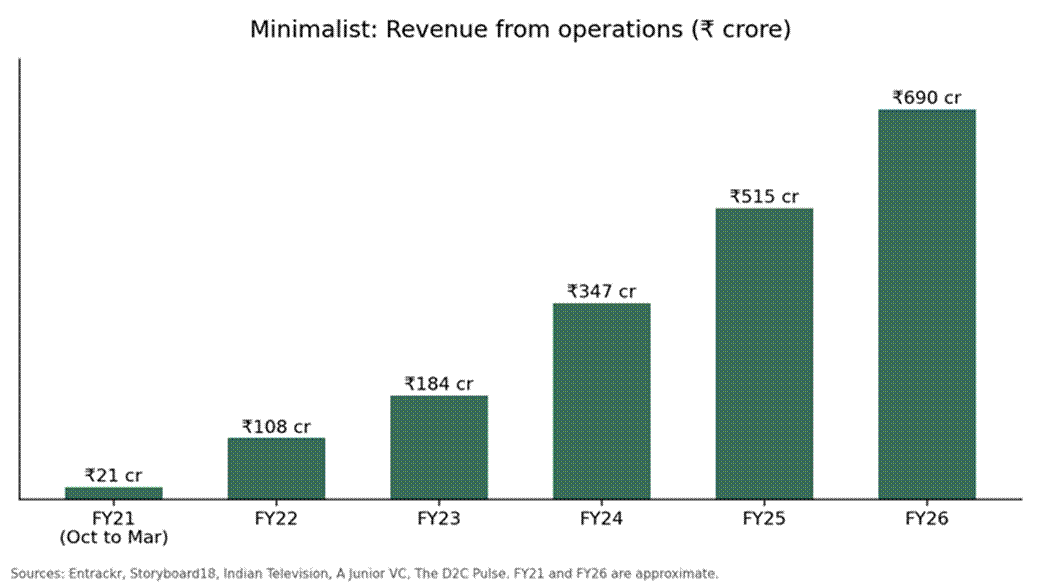
Sources: as in Exhibit 4. FY21 and FY26 are approximate.
Exhibit 6: Cost and Loyalty Indicators
Indicator | Figure |
|---|---|
Minimalist advertising spend as share of revenue (reported, varies by source) | about 25% to 35% |
Minimalist advertising spend, FY25 | ₹154 crore (about 30% of revenue) |
Mamaearth advertising spend as share of revenue, FY22 | about 42% |
WOW Skin Science advertising spend as share of revenue, FY22 | about 40% |
Minimalist cost of goods sold as share of revenue | about 30% to 35% |
Minimalist repeat purchase rate (reported) | about 60% |
Sources: A Junior VC; Forbes India; Entrackr. The 30% for FY25 is the case writer’s calculation (₹154 crore ÷ ₹514.8 crore).
Exhibit 7: HUL Deal Terms
Item | Detail |
|---|---|
Announced | 22 January 2025 |
Stake acquired | 90.5% of Uprising Science (Minimalist) |
Pre-money enterprise value | ₹2,955 crore |
Cash to existing shareholders | ₹2,670 crore |
New capital put in by HUL | ₹45 crore |
Completed | April 2025, total consideration about ₹2,706 crore |
Remaining stake | 9.5%, to be bought in about two years |
Holdings before the deal | Founders about 62%, Peak XV about 27.9% |
Implied value against FY24 revenue | about 8.5 times (case writer’s calculation) |
Founders’ role | Continue to lead the business for two years |
Sources: Entrackr; Inc42; Storyboard18.
References
1. Entrackr. (2025, 22 January). HUL acquires 90.5% stake in Minimalist at Rs 2,955 Cr valuation. https://entrackr.com/news/hul-acquires-905-stake-in-minimalist-at-rs-2955-cr-valuation-8644087
Supports: deal terms, FY23 and FY24 revenue and profit, shareholding before the deal.
2. Inc42. (2025, April). HUL completes acquisition of 90.5% stake in Minimalist. https://inc42.com/buzz/hul-completes-acquisition-of-90-5-stake-in-minimalist/
Supports: completion of the deal, ₹2,706 crore total, ₹45 crore for the remaining 9.5%.
3. Storyboard18. (2025, 24 January). From Jaipur to Jackpot: How two brothers turned skincare into a Rs 2,955 crore prize. https://www.storyboard18.com/amp/brand-makers/from-jaipur-to-jackpot-how-two-brothers-turned-skincare-into-a-rs-2955-crore-prize-54388.htm
Supports: founders’ CarDekho years, FY24 profit, reported founders’ payout.
4. Entrackr. (2026, 11 February). HUL-owned Minimalist revenue spikes 48% to Rs 515 Cr in FY25. https://entrackr.com/fintrackr/hul-owned-minimalist-revenue-spikes-48-to-rs-515-cr-in-fy25-11096050
Supports: FY25 revenue, advertising spend, EBITDA and one-time charges.
5. Indian Television. (2026). Minimalist posts 37 per cent income growth and profit in first HUL year. https://indiantelevision.com/mam/minimalist-posts-37-per-cent-income-growth-and-profit-in-first-hul-year/
Supports: FY26 revenue and profit; restated FY25 comparison (confirm date).
6. A Junior VC. (2025, 19 January). How 3,000 Cr Minimalist Became India’s Cleanest Beauty Brand. https://www.ajuniorvc.com/minimalist-unicorn-india-d2c-brand-economics-study-acquisition-unilever-journey
Supports: founder history, market size, pricing, competitors, peer advertising spend, repeat rate. Its market figures cite Statista and Deloitte, so check the originals.
7. Forbes India. Minimalist: Winning trust through transparency. https://www.forbesindia.com/article/leadership/minimalist-winning-trust-through-transparency/95533/1
Supports: 750-bottle first batch, cost of goods, run rate, HUL’s “buy rather than build” logic (confirm date).
8. Inc42. How D2C brand Minimalist built an INR 100 Cr business within eight months of inception. https://inc42.com/startups/how-d2c-brand-minimalist-built-an-inr-100-cr-business-within-eight-months-of-inception/
Supports: July 2021 Series A, Peak XV and Unilever Ventures (confirm date).
9. Blume Podcast. How Minimalist won India’s skincare market by being transparent (S4E7), with Mohit Yadav. https://blume.vc/podcasts/blume-podcast/how-minimalist-won-indias-skincare-market-by-being-transparent-s4e7-destiny-avenged-weekend-ep
Supports: founders answering every customer message for two months, ₹100 crore run rate.
10. The D2C Pulse. Minimalist brand strategy: How two brothers from Jaipur built a Rs 2,955 crore skincare brand. https://thed2cpulse.com/case-studies/minimalist-brand-strategy-case-study/
Supports: FY21 to FY24 revenue and profit. The site blocks automated access, so these figures were read from a search snippet and should be re-checked.