CASE STUDIES
How Parle-G Became an Iconic Indian Brand
How affordability, distribution, and a recognisable identity helped Parle-G become an everyday Indian brand.
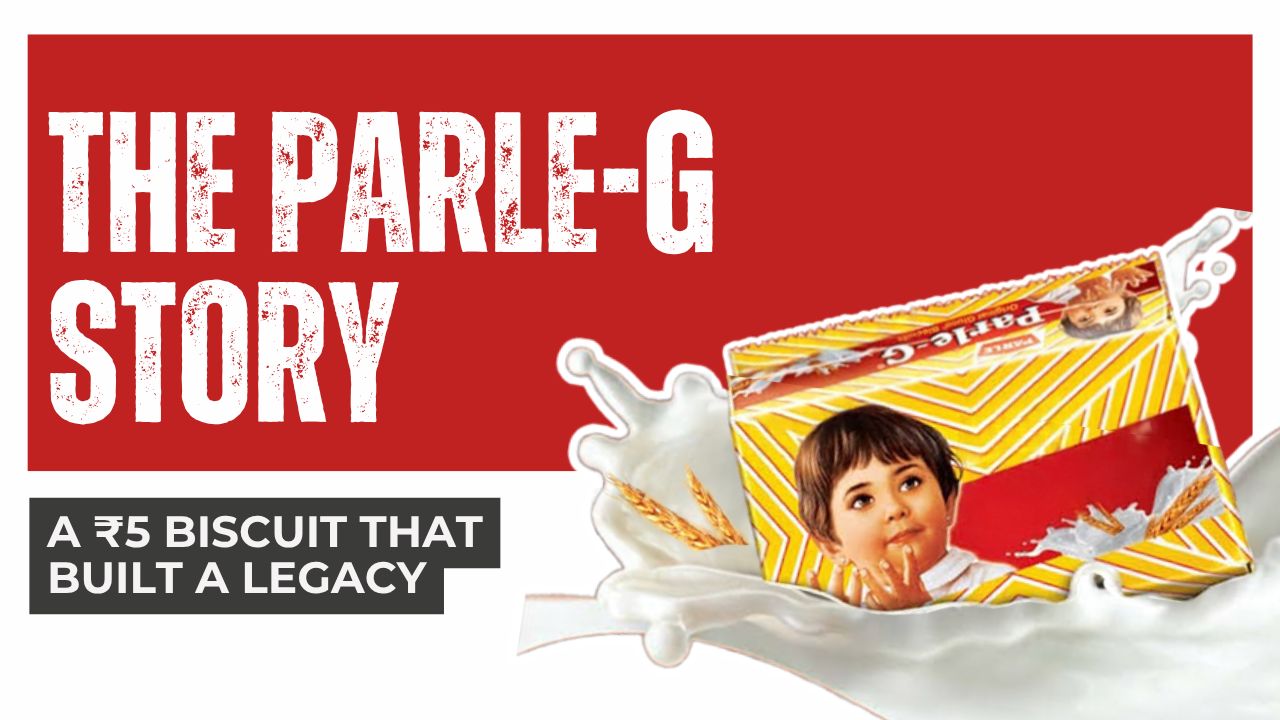
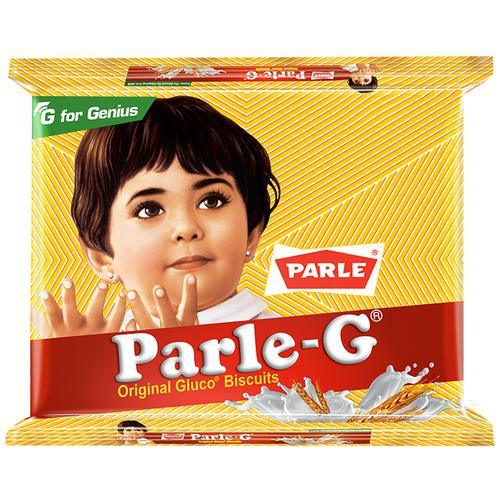
There are few Indian brands that can be recognised without seeing their name. A yellow-and-white packet. A little girl in pigtails. A cup of tea. A biscuit that costs so little that it has remained accessible across generations. That is Parle-G.
Parle-G began as Parle Gluco in 1939, when Parle baked its first biscuit. In the early 1980s, the product was rechristened Parle-G, with the “G” standing for glucose. The brand’s first television commercial followed in 1982, built around the line “Swaad bhare, shakti bhare, Parle-G.”
More than eight decades later, Parle-G remains one of the strongest examples of mass-market brand building in India. Parle Products says the brand was declared the world's largest-selling biscuit brand by Nielsen in 2003. More recently, the parent company Parle has repeatedly ranked as India's most chosen FMCG brand in Kantar's Brand Footprint rankings. In 2024, Parle recorded 7.98 billion Consumer Reach Points (CRPs), ahead of Britannia's 7.93 billion.
The interesting question, therefore, is not simply how Parle-G sold millions of biscuits.It is how a low-priced glucose biscuit avoided becoming a commodity and instead became a brand with memory, meaning and trust.
Background
The Company
The story begins with the House of Parle.
Mohanlal Dayal founded the House of Parle in 1928, and its first factory was established in Vile Parle in 1929 with 12 people producing confectionery. Parle entered biscuits in 1939 with Parle Gluco, which eventually became Parle-G.
The product entered a market where affordability mattered. Instead of building the brand around exclusivity or premium ingredients, Parle focused on making a product that ordinary Indians could buy frequently. That decision would eventually become one of its strongest competitive advantages.
From Parle Gluco to Parle-G
By the late 1970s and early 1980s, the glucose biscuit category had become crowded with similar products. Parle Gluco had a recognition problem: consumers could ask for a “glucose biscuit” without necessarily asking for Parle.
The answer was to make the brand name itself the category cue.
Around 1980, Parle Gluco was renamed Parle-G. The change was deliberately simple- the “G” retained the association with glucose while putting greater emphasis on the Parle name. The new identity was supported by television and radio advertising, including the memorable “Swaad bhare, shakti bhare” communication.
The Marketing Problem
The fundamental challenge was deceptively simple:
How do you build differentiation around a product that is inexpensive, widely available and easy for competitors to imitate?
A glucose biscuit could easily become a commodity.
That created three marketing challenges:
- Differentiation: How could Parle-G stand apart from other glucose biscuits?
- Affordability: How could the brand remain accessible without destroying its economics?
- Relevance: How could a product associated with childhood and traditional consumption remain relevant as consumer tastes changed?
Understanding the Indian Consumer
Parle's own description of its marketing philosophy highlights an understanding of the needs of the Indian masses and a value-for-money positioning designed to reach consumers across classes and age groups.
The underlying consumer insight was powerful:
Consumers did not necessarily need a better biscuit. They needed a biscuit they could trust, afford and find almost anywhere.
This created a combination of three advantages:
- Value.
Parle-G remained accessible through small packs and low price points. - Familiarity.
The taste, visual identity and basic product proposition remained remarkably consistent. - Availability.
The brand was not dependent on consumers making a special trip to find it. It became part of the everyday retail environment.
The Strategy
Parle-G's brand-building strategy can be understood through four interconnected decisions:
1. Make affordability part of the brand
Affordability became part of its identity.
The ₹5 pack became particularly important to the brand's mass-market positioning. During inflationary periods, consumers often move towards smaller packs, making low-unit-price products especially relevant. Parle executives have repeatedly linked the brand's value-for-money positioning with its continued growth.
2. Build distribution before building aspiration
Parle built an extensive distribution network reaching both urban and rural markets. Parle states that its reach extends from India's major cities to remote villages and that its brands are now sold internationally. The importance of this strategy becomes clearer when looking at consumer reach.
Kantar's Brand Footprint ranking measures Consumer Reach Points using household penetration and purchase frequency. Parle has remained India's most chosen FMCG brand for consecutive years; in the 2024 ranking it recorded 7.98 billion CRPs.
3. Turn familiarity into emotional branding
It repeatedly connected the brand with everyday Indian life. The 1982 television commercial used the family setting and the line:
“Swaad bhare, shakti bhare, Parle-G.”
Over time, communication evolved.
In 1998, Parle-G used Shaktimaan as an endorser, connecting the brand with children's popular culture. In 2004, the brand introduced the “G Maane Genius” platform. Later campaigns such as “Kal ke Genius” shifted the focus towards children's potential and achievement.
This evolution was strategically important.
4. Keep the brand recognisable
One of Parle-G's greatest assets is its visual consistency. The yellow-and-white packaging and the iconic child illustration became distinctive memory structures.
Interestingly, the famous Parle-G child is not a real child whose identity was later discovered. According to Parle's Mayank Shah, the image was an illustration created by an Everest creative in the 1960s. The stories and names attached to the girl over the years were simply consumer folklore.
That itself demonstrates the power of distinctive brand assets. Consumers created stories around the brand because the brand had become familiar enough to occupy a
The COVID-19 Moment
In 2020, Parle-G encountered an unusual situation. The country went into lockdown. Consumers began stockpiling packaged food. Migrant workers needed inexpensive food during journeys home. NGOs and individuals were distributing basic food supplies. Parle-G was particularly suited to the situation. It was inexpensive, portable, had a long shelf life and was already widely available.
Parle Products reported that Parle-G recorded its highest sales volumes in eight decades during March, April and May 2020. The company did not disclose an exact Parle-G sales figure for those months.
Results
The success of Parle-G is visible through several different measures.
- Global recognition- Parle Products states that Nielsen declared Parle-G the world's largest-selling biscuit brand in 2003.
- Consumer reach- In Kantar's 2024 Brand Footprint ranking, Parle recorded 7.98 billion Consumer Reach Points, placing it first among India's most chosen FMCG brands. Britannia followed at 7.93 billion.
- Company scae- Parle Products crossed ₹16,202 crore in net sales in FY22, becoming India's first packaged food company to cross the $2 billion annual-revenue mark, according to company filings reported by The Economic Times. Parle-G is one of the major contributors to the business, but the ₹16,202 crore figure represents Parle Products as a whole, not Parle-G alone
- Pandemic resilience-Parle-G recorded its highest sales volumes in eight decades during March–May 2020, demonstrating the strength of its value proposition and distribution network during a major demand shock.
Exhibits
Exhibit 1: Parle-G Timeline
Year | Milestone |
|---|---|
1928 | Mohanlal Dayal founded the House of Parle |
1929 | First Parle factory established in Vile Parle |
1939 | Parle baked its first biscuit, Parle Gluco |
1980/81 | Parle Gluco was rechristened Parle-G |
1982 | First Parle-G television commercial |
1998 | Shaktimaan used as Parle-G endorser |
2003 | Nielsen declared Parle-G the world's largest-selling biscuit brand |
2004 | “G Maane Genius” platform introduced |
2013 | “Kal ke Genius” campaign |
2020 | Highest Parle-G sales volumes in eight decades during March–May |
2024 | Parle ranked India's most chosen FMCG brand with 7.98 billion CRPs |
Sources: Parle Products; Economic Times; Kantar.
Exhibit 2: Parle-G's Brand Evolution
Period | Core Communication | Brand Meaning |
|---|---|---|
Early years | Glucose / nourishment | Functional value |
1982 | “Swaad bhare, shakti bhare” | Taste + strength |
1998 | Shaktimaan | Childhood + popular culture |
2004 | “G Maane Genius” | Intelligence |
2013 | “Kal ke Genius” | Children's potential |
Recent years | Family, relationships, everyday moments | Familiarity + emotional connection |
The evolution illustrates how Parle-G changed its communication without fundamentally changing the product proposition.
Exhibit 3: Selected Scale Indicators
Indicator | Figure |
|---|---|
Parle-G's first biscuit | 1939 |
Nielsen recognition as world's largest-selling biscuit | 2003 |
Parle Products FY22 net sales | ₹16,202 crore |
Rural share of Parle Products' overall sales, FY22 | ~55–60% |
Parle Products distribution expansion, FY22 | 12% |
Parle's Kantar CRPs, 2024 | 7.98 billion |
Britannia's Kantar CRPs, 2024 | 7.93 billion |
Parle-G's record-sales period | March–May 2020 |
Important: company-level figures such as ₹16,202 crore, 55–60% rural sales and 12% distribution growth relate to Parle Products, not Parle-G alone. Parle-G-specific financial figures are not publicly disclosed in the sources used here.
References
Primary / Official Sources
- Parle Products - About Us & Company History Parle Products – About Us
- Parle Products - Parle-G Official Brand Page Parle-G – Official Parle Products Page
- Parle Products - Global Presence
Useful for the brand's international distribution and manufacturing presence.
Parle Products - Worldwide Presence
Marketing / Consumer Data
- Kantar - Brand Footprint Kantar – Brand Footprint Methodology
- Kantar - Brand Footprint Report Kantar – Brand Footprint
Business & Financial Data
- Economic Times - Parle crosses $2 billion in sales during FY22 Economic Times – Parle crosses $2 billion in sales during FY22
- Economic Times - Parle-G: The humble biscuit that became the taste of India Economic Times – Parle-G: The humble biscuit that became the taste of India
COVID-19 / Record Sales
- Business Today - Parle-G sales during lockdown Business Today – Why Parle-G sales shot through the roof during lockdown
Image Reference
Cover page: https://www.quickpantry.in/products/parle-gluco-biscuits-parle-g-50-g?srsltid=AU7gw4XaTdlxc7H4nypgCsgd77DEn2TK9J011LT9xhNpu2L6XLrF8PaI