CASE STUDIES
MAGGI: THE ART OF COMING BACK
A study of Maggi’s product recall, return to shelves, and efforts to rebuild consumer trust.
Source : website
In June 2015, India's most popular instant noodle was pulled off every shelf in the country. Five months later it was back, and within a year it led its category again. This is the story of how a brand that the government called unsafe won its customers back, and of what it takes to rebuild trust once it has been publicly broken. Nestlé launched Maggi 2-Minute Noodles in India in 1983, and over three decades it became less a product than a habit. Before the crisis it held roughly three-quarters of the instant noodles market, and it accounted for almost a quarter of Nestlé India's annual sales.1, 12 Estimates of the pre-ban share vary by source, from the low 60s to the high 70s, depending on how the market is defined; Nestlé itself later used 75%.5, 8 Everything that follows starts from that position: a leader with a loyal base and, for the first time, a reason for that base to doubt it.
The Month Everything Broke
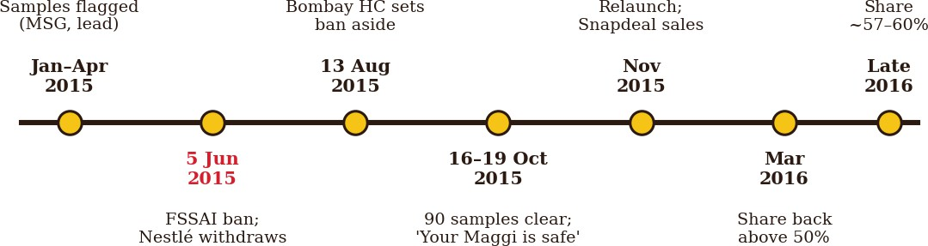
The trouble started small. In January 2015 authorities in Uttar Pradesh told Nestlé that a sample of Maggi carrying a "No Added MSG" claim had tested positive for MSG. Nestlé's reply was that it does not add MSG, and that glutamate occurs naturally in ingredients such as onion powder and hydrolysed groundnut protein, which can trigger a positive result.3 In April a referral laboratory in Kolkata reported lead above the permitted limit in one sample. By mid-May the story had reached the newspapers, and state food regulators began to act.4 On 5 June 2015 the Food Safety and Standards Authority of India (FSSAI) ordered Maggi off the market, calling it unsafe and hazardous.2 The lead figure widely quoted was 17.2 parts per million against a permitted 2.5.1 Delhi, Gujarat, Uttarakhand, Bihar and other states had already moved against the brand. Legal notices were served on the film stars who had endorsed Maggi as a healthy snack.4 Nestlé withdrew every variant and destroyed stock estimated at 35,000 tonnes or more.12 The damage went well past the shelf. Nestlé later put the cost of destroyed stock and lost sales at about ₹450 crore, and said that more than 9,000 of its suppliers had gone out of business.2, 17 A survey of India's most attractive brands, fielded while Maggi was missing from shops, dropped it from 44th place in 2013 to 100th in 2015.5 The brand did not just lose sales. It lost the thing the sales rested on.
Fighting Instead of Apologising
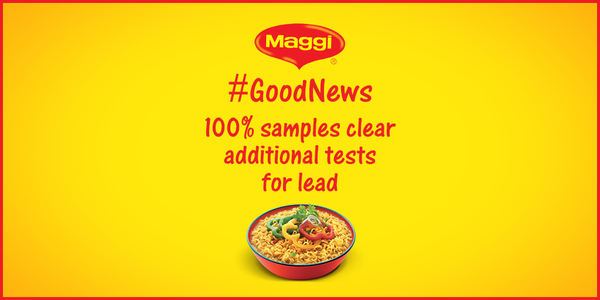
Nestlé's first big choice was to contest the finding rather than accept it. It withdrew the product, but it also went to the Bombay High Court. Its case was that the government laboratories had not been accredited for lead testing and that the process had ignored due procedure.3 On 13 August 2015 the court set aside the FSSAI order and asked for fresh testing at three accredited laboratories.2 The bench is reported to have remarked, "Even though it's a 2-minute noodles, it took us a lot of time."17 The retests did the rest. In October Nestlé announced that all 90 samples across six variants, tested by the three laboratories, were clear, with lead well below the permissible limits.2 This mattered for the comeback. A brand cannot ask people to trust it again on its own word. It needed an outside authority that could say the product was fine, and it had to win that on evidence.
Staying Alive While Off the Shelf
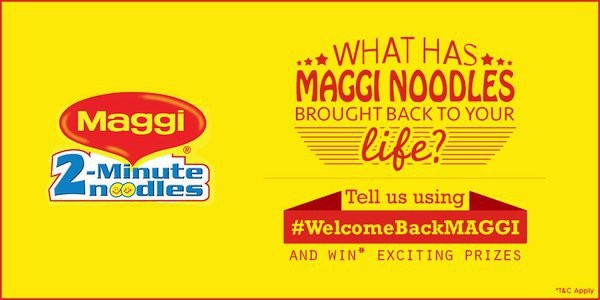
For five months Maggi could not sell anything, so it had to stay present in people's minds without a product. Nestlé went quiet on social media for about two months after the ban, answering customer queries but posting little. Once the High Court cleared the way, it came back with a series of videos under the hashtag #WeMissYouToo, with lines such as "Kab wapas aaogey" (when will you return).5, 6 The tone was affectionate rather than defensive. The brand talked like a friend who had been away, and invited people to talk back. Leadership changed in the middle of this. Suresh Narayanan joined as managing director after the crisis broke, and the work of rebuilding fell to him. In his own later words, the brand "was clinically dead in June 2015".9 The agency side was reinforced too: Publicis India kept the account and McCann Erickson India, led by Prasoon Joshi, was brought in.
Source: Compiled from references 2, 3, 4, 5, 7
The Relaunch
The return was handled in a deliberate order. On 19 October 2015, days after the clean test results, Nestlé ran a front-page print ad in the Delhi edition of The Times of India. Its line was "Your Maggi is safe, and has always been".4 Commercial sales restarted in November, at first in a limited number of outlets across about 100 cities and towns.5 The formulation was not changed.1 The "No Added MSG" claim, which had been at the centre of the first dispute, was dropped from the pack.3 The first sales channel was not a shop. Nestlé tied up with the e-commerce platform Snapdeal for flash sales on 12 and 16 November, which sold out and settled any doubt about whether five months away had hurt demand.5 It was a smart way to prove demand in public while the physical distribution chain, the slowest part of the rebuild, caught up. Within the first month Maggi had regained about 10% share and reached half a million outlets.
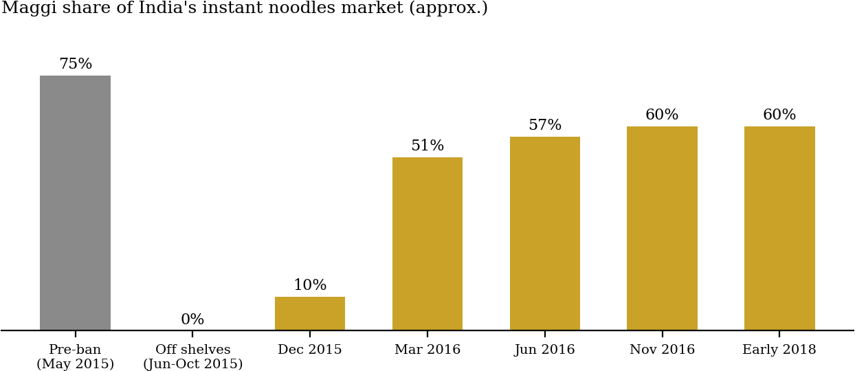
Exhibit 1. Maggi's share of the instant noodles market Figures are approximate and drawn from Nestlé statements and Nielsen data as reported in the press
(references 5, 7, 8, 9, 10). Pre-ban share is Nestlé's own figure.
How the Recovery Played Out
The recovery was steady rather than sudden. By March 2016 Maggi had recaptured 51% of the market, and the share had grown every month since the relaunch.7 By mid-2016 it stood at 57%, and in October Nestlé called the recovery sustained.8 A year after the return, Narayanan said the brand was "knocking at 60 per cent" and was back to leadership, though not yet where it had been.9 The financial picture followed. Nestlé India's shares hit a record low in February 2016 and had recovered strongly by the end of 2019, when the company was back to pre-crisis levels of sales and profit.16, 10 The share, however, stopped short of the old peak. It stayed near 58% for a few years and reached 60% only in early 2018.10 The old position was not fully won back, and competitors including ITC, Ching's Secret, Patanjali and Knorr were now serious.
Widening the Brand
Nestlé did not rebuild Maggi into the same brand. It used the reset to broaden it. In 2016 it re-launched two variants as part of a plan to strengthen the portfolio.7 It also pushed Maggi towards adults and health with Masalas of India and Nutrilicious ranges.10 The goal was to make the brand harder to knock down a second time by giving it more reasons to be bought. The result shows in the latest numbers. India is now the largest market in the world for Maggi, with about 6 billion servings sold in FY24.18 In FY26 the company reported double-digit volume growth in Maggi noodles, added a new production line at its Sanand factory, and used targeted pricing to gain share in rural India.
Where the Story Is Not Finished
The recovery did not close every file. The government's ₹640 crore class action against Nestlé, filed before the consumer commission in 2015, was revived by the Supreme Court in January 2019. The Centre argued that the central issue was not whether the noodles were harmful but whether consumers were misled through unfair trade practices, false labelling and advertising such as the "Taste bhi healthy bhi" claim.13 In 2017 a district authority in Uttar Pradesh fined Nestlé ₹45 lakh over ash content in 2015-era samples, which Nestlé said were tested against incorrect standards.12 The point for a marketer is that winning the market and closing the legal file are two different things.
Source : Maggi advertisement
What Rebuilt the Legacy
Looked at as one story, the comeback rests on a short chain. First, evidence: Nestlé fought the finding in court and let accredited laboratories settle it. Second, presence: it kept an emotional line open with customers while there was nothing to sell. Third, proof before promotion: it announced the clean results, then returned with the same product, one clear message and a digital sale that showed demand was intact. Fourth, widening: it used the reset to add variants and adult positioning, so the brand depended less on one product.
References
1. How Maggi Reclaimed India - https://thinkinsights.net/consulting/how-maggi-reclaimed-india
2. Maggi noodles safe, lab tests clear all samples: Nestle https://www.moneylife.in/article/maggi-noodles-safe-lab-tests-clear-all-samples-nestle/43722.html
3. Maggi noodles in India: overview and timeline (Nestlé) https://www.nestle-mena.com/en/ask-nestle/maggi-noodles-india/overview-timeline
4. Your Maggi is safe, says Nestlé in print ad https://www.afaqs.com/news/advertising/46019_your-maggi-is-safe-says-nestl233-in-print-ad
5. Nestle's Maggi noodles would take a long haul to return to its charm https://businesstoday.in/magazine/features/story/neslte-maggi-noodles-would-take-a-long-haul-to-retu rn-back-to-its-charm-55533-2015-12-05
6. Maggi shows love to fans on social media; aggressively promotes #WeMissYouToo videos https://www.exchange4media.com/marketing-news/maggi-shows-love-to-fans-on-social-mediaaggressi vely-promoteswemissyoutoo-videos-61495.html
7. Maggi back with a vengeance https://retail4growth.com/news/maggi-back-with-a-vengeance-1957
8. Maggi makes a comeback, wins 57% market share on sustained recovery https://businesstoday.in/latest/corporate/story/maggi-makes-a-comeback-wins-market-share-on-sustai ned-recovery-68477-2016-10-20
9. Maggi on the road to recovery; Nestle to consolidate its leadership position https://www.indiaretailing.com/?p=79028
10. Nestle needs to sustain strong Q4 performance led by volume growth (Business Standard) https://www.business-standard.com/article/companies/nestle-needs-to-sustain-strong-q4-performance -led-by-volume-growth-118021501428_1.html
11. Repositioning Maggi in India (ICMR case study) https://www.icmrindia.org/Casestudies/catalogue/Marketing/MKTG390.html
12. Nestle India's Maggi could be in hot water once again after it fails quality test (Quartz) https://qz.com/india/1140589/nestle-indias-maggi-could-be-in-hot-water-once-again-after-it-fails-qualit y-test
13. SC revives Centre's Rs 640 crore class action against Nestle in Maggi noodles case https://moneylife.in/article/sc-revives-centres-rs-640-crore-class-action-against-nestle-in-maggi-noodl es-case/56037.html
14. Maggi & KitKat Power Nestlé's Growth as India Emerges as Its Biggest Market https://agronfoodprocessing.com/maggi-kitkat-power-nestles-growth-as-india-emerges-as-its-biggestmarket/
15. Nestlé India Q2FY26 update (Sharekhan) https://www.sharekhan.com/MediaGalary/StockIdea/Nestle-Oct16_2025.pdf