CASE STUDIES
Renault in India: Anatomy of a Declining Brand in the Indian Passenger Vehicle Market
An analysis of Renault’s position in India, the car-buying journey, and possible routes to recovery.
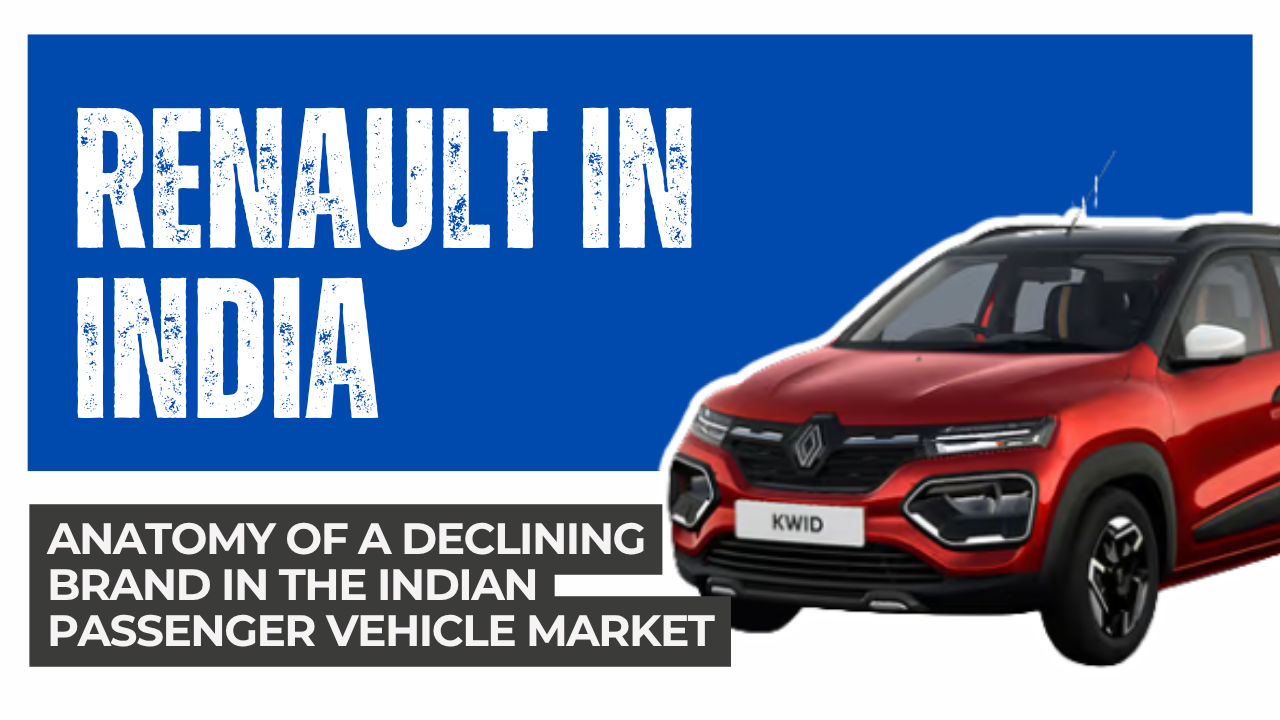
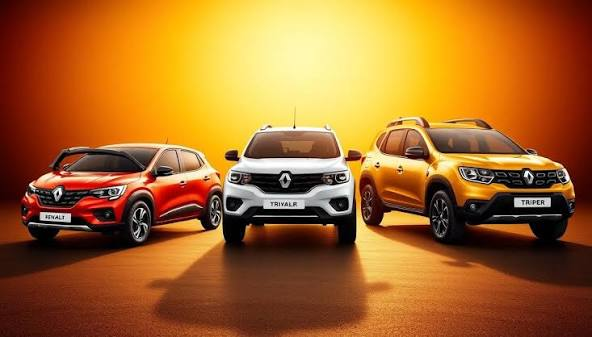
Source: Autofit.in
Case Overview
Renault India is a useful case study because its decline is documented by the company itself: a brand that once held close to 3% of the Indian passenger vehicle market now sits under 1%. Renault entered India in 2005, built its own Chennai plant in 2011 within the Renault–Nissan alliance, and was carried by the Duster (2012) and the Kwid (2015). Between 2015 and 2020 it ran 200–270 dealerships and held 2.5–3.2% share. Since 2020, leadership turnover, COVID-19, the chip shortage, and almost four years without a new model launch left it “out of the game” while rivals refreshed their SUV lineups annually (Business Standard, 2026; BW Auto World, 2026). Figure 1 shows the trajectory.
Figure 1
Renault India’s Passenger-Vehicle Market Share, 2015–2030
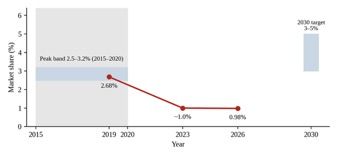
Note. Plotted points are from Business Standard (2026) and Whalesbook (2026); the shaded band marks the 2015–2020 peak range, and the 2030 band is Renault’s stated target (Business Standard, 2026).
This report traces the decline to a production-led marketing philosophy, reads the environment Renault now faces, draws on a primary survey of 157 car buyers, revisits Renault’s segmentation, targeting, and positioning (STP), and closes with a phased revival plan. Since 2025 Renault has begun correcting course through a ₹5,400 crore “Rethink” investment, a new-generation Duster, and redesigned dealerships (Autocar Professional, 2025); a 64% year-on-year sales jump in May 2026 is encouraging but not yet conclusive (Whalesbook, 2026).
Marketing Philosophy and Myopia
Philosophy Followed
Renault’s pattern matches the production concept, which assumes consumers favor affordable, widely available products and so concentrates on manufacturing efficiency and cost control (Kotler & Keller, 2016). It built around a 400,000-unit Chennai plant and a low-cost hatchback range, and all three current models (Kwid, Triber, Kiger) are priced under ₹10 lakh. Marketing was treated as optional: advertising paused for two to three years because, in the words of Renault India’s sales and marketing head, “with nothing new to sell, the brand had little reason to advertise” (Pitchonnet, 2026). Meanwhile the ₹10–20 lakh SUV bracket, where demand shifted, was never followed.
Evidence of Marketing Myopia
Levitt (1960) defined marketing myopia as defining a business by its product rather than the customer need it serves. Renault treated “an affordable small car” as a permanent market definition while Indian buyers moved toward SUVs, features, and financing flexibility. The evidence appears in four places. Portfolio: eight or nine models a decade ago have become three, absent from the segment where the Creta, Seltos, and Grand Vitara win, and with no hybrid or electric option although Tata, Mahindra, Maruti, Toyota, and Hyundai have one. Marketing: visibility lapsed for two to three years (Autocar Professional, 2026b; Pitchonnet, 2026). Network: the dealer base fell from 415 to about 350 outlets (15–16%). Financials: as Table 1 shows, profit measures fell much faster than revenue in FY24.
Table 1
Renault India’s FY24 Standalone Financial Performance
Metric | ₹ crore | Year-on-year change |
|---|---|---|
Revenue | 5,058.5 | −41.3% |
EBITDA | 111.5 | −65.4% |
Net profit | 242.2 | −40.0% |
ROCE | 6.1% | −17.6 percentage points |
Note. EBITDA = earnings before interest, taxes, depreciation, and amortization; ROCE = return on capital employed. Source: Tofler (2024).
This was not a shrinking market: Indian demand grew, and Renault Group revenue rose 3% to €57.9 billion in 2025 (Renault Group, 2026a). The problem is market-specific and philosophy-driven. Its cost shows in the survey: only 14.6% of buyers recall Renault unprompted at the start of their search.
Signs of Adaptability
The new Duster lifted May 2026 sales 64% year-on-year, though a 24% month-on-month dip shows the recovery is unstable (Whalesbook, 2026). The 2025 pivot (the “Renault. Rethink.” campaign, a new logo, “R Store” dealerships, and the ₹5,400 crore investment) is Renault’s own admission that underinvestment drove the decline (Autocar Professional, 2025; BW Auto World, 2026). The Duster (Renault Group, 2026b) and planned Boreal target the ignored SUV bracket, and leadership now speaks in segmentation terms, describing the Kiger as reaching “younger, urban professionals.” Renault appears to be adapting, but the shift is barely a year old and needs two to three years of consistent follow-through.
Marketing Environment Analysis
PESTEL. Politically, GST 2.0 (effective September 22, 2025) cut small cars under 4 m to 18%, helping Renault’s current range, while the ₹10–20 lakh bracket it wants to enter sits in a 40% slab and EVs are capped at 5% (CarDekho, 2025; Press Information Bureau, 2025). Economically, rising incomes are expanding the ₹10–20 lakh bracket fastest, where Renault had no product. Socially, buyers are more aspirational and feature-driven, and four years without a launch cost Renault mindshare. Technologically, connected features, ADAS, and hybrids are becoming baseline SUV expectations. Environmentally, tightening CAFE norms push all makers toward electrification, raising compliance exposure for Renault the longer it lacks a hybrid or EV (Bureau of Energy Efficiency, 2025). Legally, Bharat NCAP ratings (since October 2023) reward annual safety upgrades that Renault’s ageing lineup has not matched (Business Standard, 2023).
5C. The company has a strong plant and Group R&D but has underinvested for four years. Customers are value-conscious but migrating toward SUVs. Competitors (Maruti Suzuki, Hyundai, Tata, Mahindra, Kia) refresh continuously. Collaborators (the alliance and Group backing) remain intact. The context is favorable: the market grew through Renault’s decline and GST cuts are reviving demand. Table 2 summarizes the SWOT.
Table 2
SWOT Summary for Renault India
Strengths | Weaknesses |
|---|---|
Duster/SUV heritage; Group R&D scale; fully owned Chennai plant; strong global residual values | Sub-1% share; lineup capped under ₹10 lakh; dealers down from 415 to 350; no hybrid/EV; FY24 EBITDA −65% |
Opportunities | Threats |
New Duster and Boreal re-enter the ₹10–20 lakh SUV bracket; GST cuts reviving demand; strong digital lead funnel | Rival dominance in SUVs; Ford/GM India exit as precedent; further dealer attrition; slow EV/hybrid pivot |
Note. Synthesized from the PESTEL and 5C analysis above and the sources cited there.
Consumer Purchase Journey
A structured survey of 157 consumers and prospective buyers traced the purchase journey (the sample is young, with 94.3% under 30, so it resembles a first-time buyer’s view). Figure 2 shows what triggered shopping. The two largest needs, an affordable city car and more seats, account for 85.4% of respondents; price and word of mouth, not advertising, most often set the decision in motion.
Figure 2
What Triggers Car Shopping
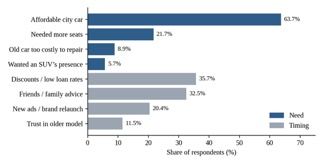
Note. N = 157. Source: primary consumer survey conducted for this case study (2026). Respondents could select more than one timing trigger.
Table 3 maps the journey. Need recognition is personal (73.9% self-initiated), so a brand must reach the individual directly. Search is where awareness is made or missed, and evaluation is third-party driven: 62.4% rely on expert video reviews and online comparisons against 8.3% for a salesperson, and about six in ten check the after-sales network, which exposes Renault’s shrinking dealer base. Decisions are mostly joint (38.2% with family, 31.8% alone, 22.9% by parents), so messaging aimed only at the young shopper misses whoever signs for the loan.
Table 3
Stages of the Car Purchase Journey
Stage | What buyers look for | Who drives it | Duration |
|---|---|---|---|
Need recognition | Budget and the underlying need | Self (73.9%) | Instant |
Information search | Price, specs, safety; brand awareness forms | Self-driven research | 1–4 weeks (41.4%) to 1–3 months (40.1%) |
Evaluating alternatives | Expert reviews, owner feedback, dealer and resale strength | Self, family, friends, dealer staff | Overlaps search |
Purchase decision | On-road price, loan terms, test drive | Joint/family (61.1%) | Days |
Purchase and delivery | Delivery timeline, paperwork | Dealership | Under 1 month (38.2%) to 1–3 months (33.1%) |
Note. N = 157. Source: primary consumer survey conducted for this case study (2026).
For Renault, product fit is real but partial, brand recall arrives too late, and the search stage, not the showroom, is the real battleground.
Segmentation, Targeting, and Positioning
Segmentation
Renault has segmented almost entirely by price and body type, treating “the value buyer” as one group: supply-led rather than demand-led segmentation. The MRSI–MRUC Socio-Economic Classification (SEC) offers a sharper, India-specific basis, grading households A1–E3 by the chief earner’s education and ownership of 11 durables (BestMediaInfo, 2011; PPMS, 2026). Because car ownership is itself a durable, SEC works best as an affluence proxy layered on behavioral segmentation. A1–A3 households are about 5.4% of India, B1–B2 about 9.6%, C1–C2 about 15.4%, and D1–E3 about 69.6% (PPMS, 2026). Table 4 gives the two segments that result.
Table 4
Proposed Customer Segments for Renault India
Dimension | Segment A: Value-first buyers | Segment B: Aspirational upgraders |
|---|---|---|
SEC base | B2–C2 (about 20% of households); 3–5 durables | A3–B1 (about 5%); graduate/postgraduate earner, 6+ durables |
Profile and trigger | First-time or two-wheeler upgraders, under 30; budget (63.7%) or seating (21.7%) driven | Metro families aged about 30–45; SUV presence; expert-review driven; joint financing (38.2%) |
Product fit | Kwid, Triber, Kiger | New Duster; planned Boreal |
Note. SEC shares from PPMS (2026) and BestMediaInfo (2011); survey percentages from the primary consumer survey (2026). Segment B rests partly on secondary evidence.
Targeting
Targeting has followed segmentation by default. Undifferentiated targeting cannot hold price-sensitive and aspirational buyers in one lineup, and concentrated targeting would cede the fastest-growing bracket to rivals. We recommend differentiated targeting: two go-to-market efforts sharing one plant and dealer network. Segment A is the volume base to defend, moved by discounts and loan rates (35.7%) and word of mouth (32.5%), so dealer trust and price transparency hold it cheaply. Segment B is the strategic priority on which the Rethink investment is staked. Because the survey skews toward Segment A, Segment B decisions should be validated with interviews of 30–45-year-old family-upgrade buyers.
Positioning
Positioning has been inconsistent and largely silent: the Kwid and Triber lean on price, the Kiger on “SUV styling at a small-car price,” and the Duster on SUV heritage, yet only 14.6% of buyers recall Renault unprompted. Figure 3 shows in Panel A Renault’s lineup clustered below ₹10 lakh until the new Duster, and in Panel B Renault trailing every mainstream rival on trust. Fixing only one axis will underdeliver.
Figure 3
Perceptual Maps of Renault’s Positioning
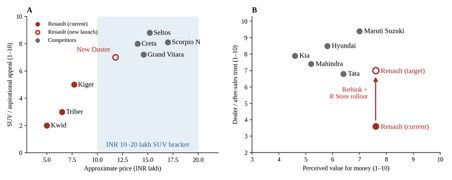
Note. Panel A plots price against SUV and aspirational appeal; Panel B plots perceived value for money against dealer and after-sales trust, the factor about six in ten buyers check (primary consumer survey, 2026). Positions are illustrative (approximate prices; judgment-based scores) from secondary sources including Autocar Professional (2026b) and Renault Group (2026b), not a primary brand-perception survey. The arrow in Panel B marks the position the Rethink investment and R Store rollout aim to reach.
We recommend a two-tier positioning under one promise, “more car for your money, and more say in how it looks and drives”:
• Segment A (Kwid, Triber, Kiger): “The smart, no-compromise first car,” positioned against Maruti and Hyundai entry hatchbacks on dealer and spare-parts confidence and price transparency.
• Segment B (Duster, Boreal): “A real SUV, not a tall hatchback,” positioned against the Creta and Seltos on genuine SUV heritage, earned in the review channels this segment trusts.
Success should be tracked through whether the dealer count stabilizes and the 14.6% unprompted-recall figure rises.
Product Mix, PLC Stage, and Revival Plan
Renault sells three models, all under ₹10 lakh: little width (one price band) and shallow depth, with no hybrid or EV. Overall, the portfolio is in the decline stage of the product life cycle (PLC), with falling sales, shrinking distribution, reduced promotion, and lost share while the industry grew. The new Duster behaves like a reintroduction, and Renault is pursuing rejuvenation rather than accepting decline. Table 5 sets out the revival plan.
Table 5
Phased Revival Action Plan
Priority | Key actions | Timeline |
|---|---|---|
Widen the product line | Fast-track Duster and Boreal in the ₹10–20 lakh SUV bracket; keep refreshing Kwid, Triber, and Kiger with feature and safety updates | 0–18 months |
Rebuild the dealer network | Grow from about 350 toward 415+ outlets, prioritizing tier-2/3 cities; continue the R Store redesign | 6–24 months |
Make marketing continuous | Run an always-on calendar; shift spend to third-party reviews (62% influence versus 8.3% for salespeople); target the 1–4 week search window with digital and SEO | 0–12 months |
Fix financing and household messaging | Flexible EMI and exchange schemes (discounts and loan rates trigger 35.7%); family-oriented campaigns, since about 40% of decisions are joint | 0–6 months |
Close the technology gap | Launch a hybrid or EV; add ADAS and connected features to meet buyer expectations and Bharat NCAP standards | 12–36 months |
Track progress | Review market share, dealer count, and month-on-month Duster sales quarterly | Ongoing |
Note. Derived from the survey findings (2026) and the sources cited in earlier sections. SEO = search engine optimization; EMI = equated monthly installment.
Conclusion
Renault India is a capable manufacturer trapped by a production-led philosophy: an efficient plant and a good value product were treated as sufficient while buyers moved toward SUVs, features, and financing flexibility. The myopia shows in a three-model sub-₹10 lakh portfolio, years of marketing silence, a dealer network buyers check and cannot rely on, and an STP never built for more than one buyer. Renault’s response since 2025 is right on paper, and whether the May 2026 bump becomes real recovery will depend on a deliberate, differentiated STP and sustained follow-through in dealer count, brand recall, and product cadence.
References
Autocar Professional. (2025). Renault Rethink: A new India strategy at the core of global growth play. https://www.autocarpro.in/news/renault-rethink-a-new-india-strategy-at-the-core-of-global-growth-play-126023
Autocar Professional. (2026b, January 27). Renault targets India market share recovery to 3–5% by 2030. https://www.autocarpro.in/news/renault-targets-india-market-share-recovery-to-3-5-by-2030-130766
BestMediaInfo. (2011, May). MRUC & MRSI introduce new socio-economic classification system. https://bestmediainfo.com/2011/05/mruc-mrsi-introduce-new-socio-economic-classification-sec-system
Bureau of Energy Efficiency, Ministry of Power, Government of India. (2025). Corporate Average Fuel Efficiency (CAFE) norms. https://beeindia.gov.in/show_content.php?lang=1&level=2&ls_id=346&lid=7
Business Standard. (2023, August 23). Buckling up: India launches first car crash test programme “Bharat NCAP.” https://www.business-standard.com/industry/auto/centre-launches-india-s-first-car-crash-testing-safety-rating-programme-123082200816_1.html
Business Standard. (2026, January 27). Renault aims to lift India market share to 3-5% by 2030, says CEO. https://www.business-standard.com/industry/auto/renault-eyes-3-5-pc-market-share-in-india-by-2030-ceo-126012701146_1.html
BW Auto World. (2026). Renault India MD breaks silence on market share crash, reveals roadmap to revival. https://bwautoworld.com/article/renault-india-md-breaks-silence-on-market-share-crash-reveals-roadmap-to-revival-565144
CarDekho. (2025). GST Council meeting: New GST rates for small cars, luxury cars, bikes under 350cc, three-wheelers, now at 18% as they get GST cut! https://www.cardekho.com/india-car-news/gst-council-meeting-new-gst-rates-small-cars-luxury-cars-bikes-under-350cc-and-threewheelers-get-cheaper-with-new-18-gst-slab-34973.htm
Kotler, P., & Keller, K. L. (2016). Marketing management (15th ed.). Pearson Education.
Levitt, T. (1960). Marketing myopia. Harvard Business Review, 38(4), 45–56.
Pitchonnet. (2026, February 26). “It would be a massive investment with Duster”: Francisco Hidalgo, Renault India. https://www.pitchonnet.com/brandtalk/it-would-be-a-massive-investment-with-duster-francisco-hidalgo-renault-india-39113.html
PPMS. (2026). Socio-economic classification (SEC) & NCCS in Indian retail marketing. https://ppms.in/blog/socio-economic-classification-in-retail-marketing/
Press Information Bureau, Government of India, Ministry of Finance. (2025, September 3). Recommendations of the 56th meeting of the GST Council. https://www.pib.gov.in/PressReleasePage.aspx?PRID=2164586
Renault Group. (2026a). 2025 full year results—Financial report. https://events.renaultgroup.com/app/uploads/sites/7/2026/02/RG_2025_FY_Results_Financial-Report_EN.pdf
Renault Group. (2026b). Renault Duster: The compact SUV reinvents an iconic model in India. https://www.renaultgroup.com/en/magazine/our-group-news/in-india-renault-duster-opens-a-new-chapter/
Tofler. (2024). Renault India Private Limited company financials, FY24 (standalone). https://www.tofler.in/renault-india-private-limited/company/U34100TN2005FTC078835
Whalesbook. (2026, June). Renault India sales rise 64%, yet market share remains thin. https://www.whalesbook.com/news/English/auto/Renault-India-Sales-Rise-64percent-Yet-Market-Share-Remains-Thin/6a1d8babcc8b4288bbd0c6a7