CASE STUDIES
When Localization Goes Wrong: The Dolce & Gabbana China Crisis
What Dolce & Gabbana’s China campaign reveals about localization, cultural judgement, and crisis response.
Introduction
On the morning of 21 November 2018, Domenico Dolce and Stefano Gabbana were hours from the biggest show in their company’s history. The Great Show was billed as a tribute to China, and it was due to start that evening in Shanghai. Vogue reported 360 looks and 140 performers, while WWD cited roughly 500 looks (Note 1). The founders described it as something created with love and passion for China.
By that morning, however, the promotional campaign for the show had become a national controversy. Overnight, screenshots of direct messages attributed to Gabbana circulated: Diet Prada posted them several hours before the show, in which he appeared to criticize China while defending the campaign. Chinese celebrities scheduled to attend were withdrawing, and Zhang Ziyi, Chen Kun, and Wang Junkai announced they would not come.
The founders had to decide how to respond within hours, and whatever they chose would shape the brand’s standing with a customer base that Bain & Company estimated made up a third of global luxury spending. This case asks how the company arrived at that moment, what happened next, and what the brand’s trajectory since then suggests about localization, governance, and crisis response in luxury marketing.
Background
The Company
Dolce & Gabbana (D&G) was founded in Milan in 1985 by Domenico Dolce and Stefano Gabbana. It is privately held and does not publicly disclose its results, so most financial information comes from regulatory filings and press reports. In the fiscal year ended March 2019, revenue grew 4.9% to €1.38 billion (Exhibit 3).
The China Opportunity
In 2018, Bain & Company and Altagamma found that Chinese consumers accounted for 33% of global luxury spending, up from 32% in 2017. Generations Y and Z accounted for 47% of luxury consumers and 33% of purchases. Luxury sales in mainland China grew 18% in 2018. Bain forecasts that Chinese consumers will account for 46% of the global market by 2025, with half of their purchases made at home (Exhibit 1).
D&G’s own exposure was large but not precisely known. Vogue reported that China accounted for about 30% of group revenue, and a Gartner L2 study estimated that the market accounted for around a third of the brand’s total sales. The company has never confirmed either figure. It operated nearly 60 stores in China.
A Localization Template
D&G had run “DG Loves” campaigns in other Asian markets as part of a strategy to localize the brand in Japan and Hong Kong. China was the next stop.
The First Warning: April 2017
In April 2017, ahead of its first Beijing show, D&G ran a #DGLovesChina campaign. The images showed models posing among locals and tourists at Tiananmen Square, in the hutongs, and at the Great Wall. Chinese consumers criticized the images for stereotyping the country and presenting a “backward” view rather than a modern one. Commenters contrasted the images with those from the earlier “DG Loves Japan” campaign, which featured young people in modern settings. D&G deleted the photos from Weibo and WeChat.
The Great Show Campaign
The Videos
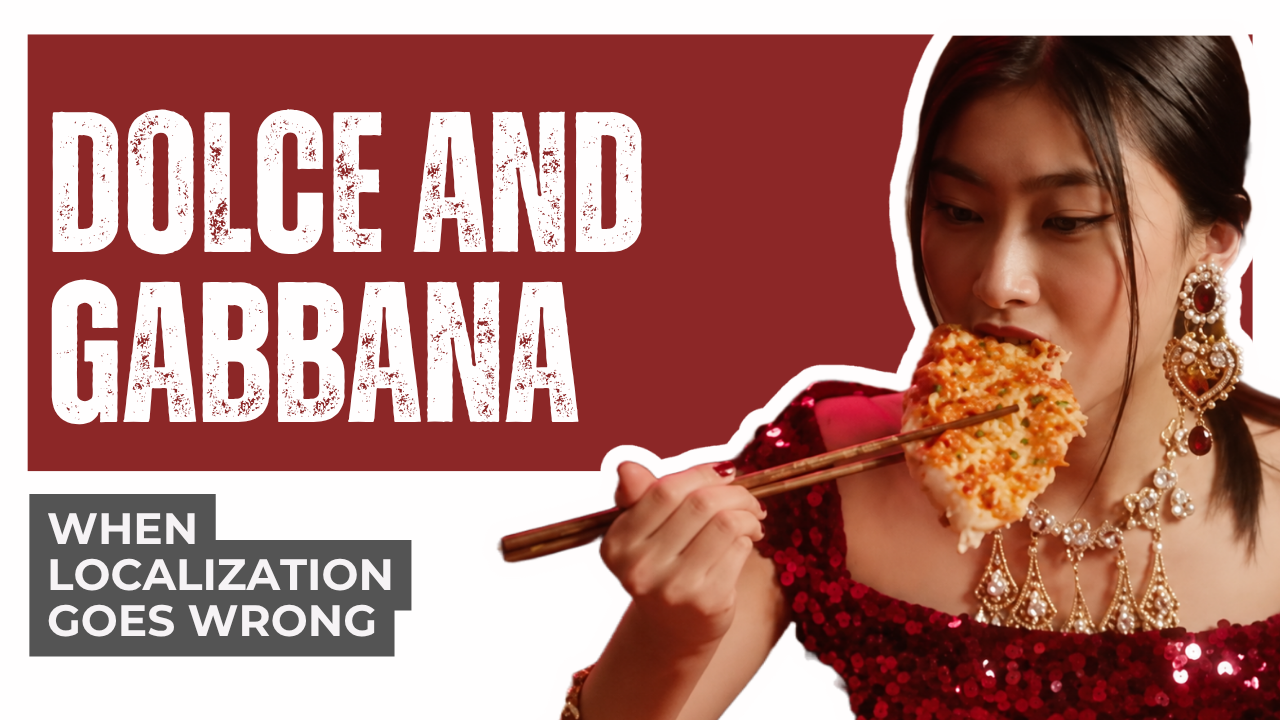
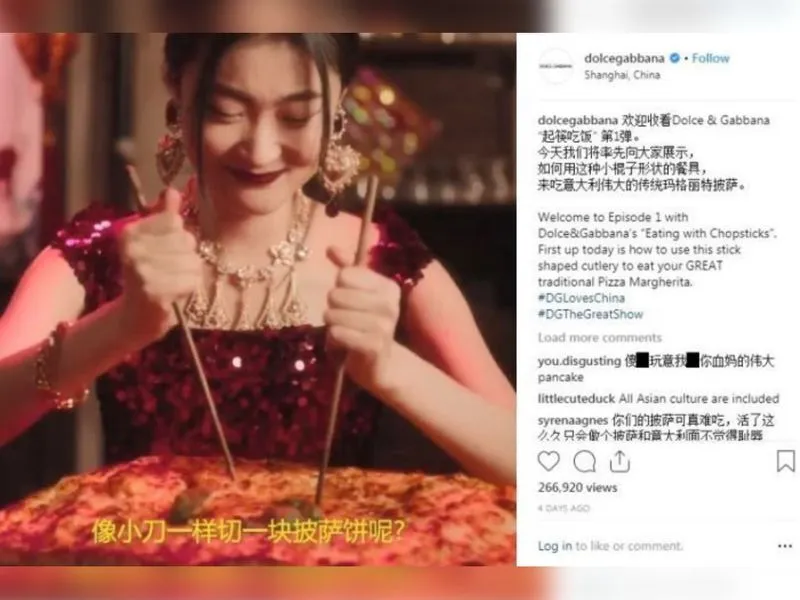
Roughly nineteen months later, the brand used the same hashtag. On 17 November 2018, D&G posted three promotional videos on Weibo and Instagram, titled “Eating with Chopsticks”. Each showed an Asian model in a lavish dress, with Chinese folk music playing in the background, trying to eat pizza, spaghetti, or cannoli with chopsticks. Reports described lanterns and couplets in the background. The Mandarin voiceover was deliberately mispronounced to mock Chinese speech. In the cannoli episode, the narrator asked whether it was “too big” for her, which many viewers read as a sexual innuendo. The posts carried the hashtags #DGLovesChina and #DGTheGreatShow.
Critics said the videos showed no respect for Chinese culture and perpetuated stereotypes about Chinese women, citing the model’s styling.
The Backlash
D&G removed the videos from Weibo within 24 hours, but not before the “Boycott Dolce” hashtag had been discussed more than 18,000 times. They remained on D&G’s Instagram account, which is blocked in mainland China, and some users reached it by other means to post criticism there.
The Messages
Diet Prada, an anonymous-turned-public fashion watchdog account, then published screenshots of an exchange from an account attributed to Gabbana. In the exchange, he reportedly said the brand’s team had pulled the videos against his wishes, and he made derogatory remarks about China and Chinese people.
Twenty-four hours
On 21 November, the situation moved quickly (Exhibit 2):
- Withdrawals. Celebrities pulled out, and a Chinese modeling agency announced that 24 models it represented would join the boycott.
- Cancellation. The show was canceled hours before it was due to begin. According to Diet Prada, the Shanghai Cultural Affairs Bureau canceled it. Diet Prada and several outlets report this attribution, and the company’s own statement framed it differently (Note 2).
- The company’s response. D&G said its Instagram account and Gabbana’s had been hacked, and that its legal office was investigating. Time later reported that the leaked messages included Gabbana saying the videos were posted “by my will”. A news report counted three statements in all: a hacking claim, thanks to the people who worked on the show, and declarations of love for China.
On 22 November, the commercial consequences began:
- Tmall, JD.com, Yanxuan, and Vipshop delisted D&G products, and JD.com confirmed the removal.
- Kaola, Secoo, Yoox Net-a-Porter, and Lane Crawford also dropped the brand, and Bloomberg reported thousands of products removed from China’s largest shopping sites.
- A duty-free shop in Haikou posted a photo of empty D&G shelves.
- Official media joined in. The People’s Daily reported a national boycott, and state media warned the brand that it was risking the Chinese market.
Consumers took their own action. A Shanghai-based director burned more than $20,000 worth of D&G products, and store windows were plastered with “Not me” posters mocking the hacking claim. Gartner recorded that mentions of the brand on Weibo surged by 2,512%.
On 23 November, the founders released a video in which they expressed their love for China and said “sorry” in Mandarin. Gabbana said the episode would never be forgotten and would not happen again. The apology came after the first wave of boycotts and delistings, and brand ambassadors Dilraba and Wang Junkai announced they were cutting ties.
Aftermath
Commercial Position
Two months later, Business of Fashion described D&G as effectively blocked in China, absent from Tmall, JD.com, and the China sites of Net-a-Porter and Farfetch, and silent on Weibo since 23 November. L2 found that in the first quarter of 2019, the brand’s social media engagement was down 98% compared with the previous year. Brand Finance estimated at the time that the scandal could wipe up to 20% off the brand’s value (Note 3).
Financial Results
Despite the freeze, the group as a whole continued to grow. In fiscal 2019, Asia-Pacific fell from 25% to 22% of turnover while the Americas rose from 13% to 16%, and the group expected Greater China sales to decline the following year, with costs at almost 60% of revenue (Exhibit 3). The case writer’s own calculation, based on rounded shares, implies that Asia-Pacific revenue fell by roughly 7-8% in absolute terms (Note 4).
Litigation
In 2019, D&G filed a defamation suit in Milan against the founders of Diet Prada. When the suit became public in 2021, press reports said it sought €450 million to restore the brand image since 2018, along with itemized claims of about €89.6 million for lost Asian sales between November 2018 and March 2019 and over €8.6 million for the canceled show (Exhibit 6). These figures are a litigant’s claims, not audited losses.
Long-Run Position
By 2021, the brand’s boutique count in China had fallen from 58 to 47, and it remained absent from Tmall and JD.com. It had not signed a major mainland Chinese name since the incident. When a pop star wore the brand in 2021, it triggered a fresh social media uproar. One consulting report describes later attempts to rebuild, including the use of two virtual idols to model a capsule collection.
In 2024, CEO Alfonso Dolce said that the US and Canada together represented 28% of turnover, compared with 16% for China. Group revenue then was €1.871 billion, up 17%. In the year to March 2025, revenue reached €1.9 billion, but fashion and home sales fell by 8%, with contractions in Europe, China, and Asia, and net financial debt stood at €453 million (Exhibit 5). In 2026, Gabbana stepped down as chair, effective 1 January, while keeping his creative role as the company negotiated a €450 million debt refinancing. Former Gucci CEO Stefano Cantino was named co-CEO in April.
The latter financial strain cannot be attributed solely to the 2018 crisis. The group also lost more than €100 million in revenue due to the Russia–Ukraine war, and luxury demand slowed more broadly.
A Reference Point: The 2019 T-Shirt Cases
In August 2019, three other luxury brands faced a separate controversy in China. Versace, Coach, and Givenchy were criticized for T-shirts that listed Hong Kong, Macau, or Taiwan as separate countries. Versace apologized on 11 August after its newly signed Chinese ambassador, Yang Mi, ended her contract. Coach and Givenchy followed the next day. Coach said it pulled the shirt from all global channels. The brands still lost ambassadors Liu Wen and Jackson Yee. Those cases involved a product error and swift apologies, with no founder messages attached (Exhibit 7).
Decision Points for Discussion
21 November 2018, morning. With hours to go before the show, what should the founders have done? Consider proceeding, canceling, or issuing a public apology first. What information would you need?
The hacking claim. What did the company gain and lose by saying its accounts had been hacked? How should it have sequenced its statements?
Governance. If the reported exchange is accurate, the brand’s team removed the videos, and the founder objected. What controls should a founder-led luxury house have over content and personal social media?
Localization. What would genuine localization of this show have required? Who should have held authority over the concept?
Rebuilding. Eight years on, D&G is still absent from China’s largest e-commerce platforms, according to most reports. What should the new leadership do about China? Should it invest, wait, or reallocate effort to other markets?
Dependency. How should a luxury house with roughly a third of its sales exposed to one market manage that risk?
Notes
1. Reports differ on the size of the show. Vogue’s figures (360 looks, 140 performers) appeared in Fox News coverage, while WWD cited roughly 500 looks. No reliable guest count was found.
2. The attribution of the cancellation to the Shanghai Cultural Affairs Bureau comes from Diet Prada and outlets repeating it. The company’s statement described the cancellation without assigning responsibility.
3. Brand Finance’s estimate was reported through the Los Angeles Times and Knowledge at Wharton and is a forecast, not a measured outcome.
4. Case writer’s calculation: prior-year revenue ≈ €1.38 billion ÷ 1.049 ≈ = €1.316 billion. Asia-Pacific at 25% ≈ €329 million, falling to 22% of €1.38 billion ≈ , €304 million. Shares are rounded, so this is approximate.
Exhibits
Exhibit 1: The China Luxury Opportunity (Bain & Company / Altagamma)
Indicator | Figure |
|---|---|
Chinese share of global luxury spend, 2017 | 32% |
Chinese share of global luxury spend, 2018 | 33% |
Mainland China luxury sales growth, 2018 | 18% |
Gen Y and Z share of luxury consumers/purchases, 2018 | 47% / 33% |
Forecast Chinese share of global market, 2025 | 46% |
Exhibit 2: Timeline, November 2018
Date | Event |
|---|---|
17 Nov | Three “Eating with Chopsticks” videos were posted on Weibo and Instagram. |
Within 24 hours | Videos removed from Weibo; “Boycott Dolce” discussed 18,000+ times |
20–21 Nov | Diet Prada posts screenshots attributed to Gabbana |
21 Nov | Celebrities withdraw; show canceled; D&G says accounts hacked. |
22 Nov | Tmall, JD.com, Kaola, Secoo, Yoox Net-a-Porter, and others delist D&G |
23 Nov | Founders release apology video. |
Exhibit 3: D&G Group Results, Fiscal Year Ended March 2019 (from Reuters report of filing)
Item | FY2018 | FY2019 |
|---|---|---|
Revenue | ≈ €1.32bn (case writer estimate) | €1.38bn (+4.9%) |
Asia-Pacific share of turnover | 25% | 22% |
Americas' share of turnover | 13% | 16% |
Implied Asia-Pacific revenue | ≈ €329m | ≈ €304m (case writer estimate) |
Exhibit 4: Indicators of Brand Damage
Indicator | Figure |
|---|---|
Weibo mentions of D&G | +2,512% |
Social engagement, Q1 2019 vs Q1 2018 | −98% |
Boutiques in China, 2018 → 2021 | 58 → 47 |
Exhibit 5: Later Group Indicators
Item | Figure |
|---|---|
FY2024 revenue | €1.871bn (+17%) |
China's share of turnover (CEO, 2024) | 16% |
FY2025 revenue | €1.9bn (+4%) |
FY2025 net financial position | −€453m |
The 2018 China share (reportedly 30% to a third) and the 2024 share (16%) come from different sources and may use different definitions.
Exhibit 6: Damages Claimed by D&G in Its Diet Prada Suit (reported by AP, 2021)
Claim | Amount |
|---|---|
Lost Asian sales, Nov 2018–Mar 2019 | ≈ €89.6m |
Show cancellation | ≈ €8.6m |
Restoring brand image since 2018 | €450m |
Exhibit 7: Comparison of Responses, 2019 T-Shirt Cases
Brand | Ambassador loss | Response |
|---|---|---|
Versace | Yang Mi | Apology 11 Aug; shirt withdrawn |
Coach | Liu Wen | Apology 12 Aug; shirt pulled from all channels |
Givenchy | Jackson Yee | Apology on Weibo 12 Aug |
References
- Bain & Company / Altagamma. (2018). The Future of Luxury: A Look into Tomorrow to Understand Today (Luxury Goods Worldwide Market Study, Fall–Winter 2018). https://www.bain.com/insights/luxury-goods-worldwide-market-study-fall-winter-2018/
Supports: 33% share, Gen Y and Z figures, 46% forecast for 2025. - Bain & Company. (2018). The personal luxury goods market recorded positive growth in 2018, reaching €260 billion (press release). https://www.bain.com/about/media-center/press-releases/2018/fall-luxury-goods-market-study/
- American Marketer. (2018, 16 November). Luxury market growth continues as Chinese, Gen Z influence increases: Bain. https://americanmarketer.com/2018/11/16/luxury-market-growth-continues-as-chinese-gen-z-influence-increases-bain/
Supports: Mainland China luxury sales up 18% in 2018. - Jing Daily. (2017, 25 April). Dolce and Gabbana campaign sparks controversy on China's social media. https://jingdaily.com/posts/dolce-gabbana-campaign-controversy
- The Drum. (2017, 28 April). Dolce & Gabbana pulls campaign from Weibo and WeChat following a public backlash. https://www.thedrum.com/news/dolce-gabbana-pulls-campaign-weibo-and-wechat-following-public-backlash
Supports: the Japan and Hong Kong localization template.NextShark. (2017, 25 April). Dolce & Gabbana causes outrage in China for revealing Beijing's "ugly side". https://nextshark.com/dolce-gabbana-causes-outrage-china-revealing-beijings-ugly-side
Supports: comparison with "DG Loves Japan".
The videos, cancellation, and boycott (November 2018)
- NPR Goats and Soda. (2018, 1 December). Dolce & Gabbana ad (with chopsticks) provokes public outrage in China. https://www.npr.org/sections/goatsandsoda/2018/12/01/671891818/dolce-gabbana-ad-with-chopsticks-provokes-public-outrage-in-china
Supports: the mocking voiceover, the "too big" line, store count, the 23 November apology. - The China Project. (2018, 21 November). Dolce & Gabbana cancel Shanghai show after chopstick video controversy. http://thechinaproject.com/2018/11/21/dolce-gabbana-cancels-shanghai-show-after-chopstick-video-controversy/
Supports: the 17 November posting date. - Fox News. (2018, 21 November). Dolce & Gabbana cancels major Shanghai show after outcry over "racist" ads. https://www.foxnews.com/lifestyle/dolce-and-gabbana.amp
Supports: the Vogue figures of 360 looks and 140 performers. Find the original Vogue article, too. - Fashionista. (2018, 21 November). Dolce & Gabbana spark racism controversy with #DGLovesChina campaign. https://fashionista.com/2018/11/dolce-gabbana-chopsticks-chinese-ad-racist
Supports: the claim that the team deleted the videos, and the Shanghai Cultural Affairs Bureau attribution. - Fortune. (2018, 21 November). Dolce & Gabbana cancels Shanghai fashion show after backlash over "racist" ads. https://fortune.com/2018/11/21/dolce-gabbana-cancels-shanghai-fashion-show-racist-backlash
- The Hollywood Reporter. (2018, November). Dolce & Gabbana cancels China show, blames controversy on hack. https://www.hollywoodreporter.com/news/dolce-gabbana-cancels-china-show-blames-controversy-hack-1163263
Supports: the hacking statement. - Time. (2018, 23 November). Dolce & Gabbana issues apology to China after backlash over ads.
Delistings and retailer reaction
- Caixin Global. (2018, 22 November). E-commerce sites drop Dolce & Gabbana products amid public outcry. https://www.caixinglobal.com/2018-11-22/e-commerce-sites-drop-dolce-gabbana-products-as-public-outcry-grows-101350933.html
- South China Morning Post. (2018, 22 November; updated 23 November). Chinese e-commerce sites remove Dolce & Gabbana products after anti-China slur from the company's founder. https://www.scmp.com/tech/e-commerce/article/2174463/chinese-e-commerce-sites-remove-dolcegabbana-products-after-anti
Supports: the celebrity withdrawals and Xiaohongshu. - Fortune. (2018, 23 November). Online stores in China are dumping Dolce & Gabbana over its "racist" chopsticks ad. https://fortune.com/2018/11/23/dolce-and-gabbana-china-ad-online-stores
- Associated Press via The Washington Times. (2018, 22 November). Dolce & Gabbana goods were pulled in China over alleged insults. https://www.washingtontimes.com/news/2018/nov/22/dolce-gabbana-goods-pulled-china-over-alleged-insu/
Supports: the Haikou duty-free shelves. - Women's Wear Daily. (2018, November). Dolce & Gabbana: assessing the fallout. https://wwd.com/fashion-news/fashion-features/feature/dolce-gabbana-surviving-china-controversy-1202912436/
Supports: the roughly 500 looks. - Bangkok Post (Bloomberg). (2018, November). Dolce & Gabbana China blunder rages on. https://www.bangkokpost.com/business/1580378/dolce-gabbana-china-blunder-rages-on
Supports: thousands of products removed. - Gulf News. (2018, November). Dolce & Gabbana's China controversy: what happened. https://gulfnews.com/amp/lifestyle/fashion/dolce--gabbanas-china-controversy-what-happened-1.60547418
Financial and brand impact
- Business of Fashion / Reuters. (2019, 28 August). Dolce & Gabbana sees sales slowdown in China after ad backlash. https://www.businessoffashion.com/news/luxury/dolce-gabbana-sees-sales-slowdown-in-china-after-ad-backlash/
Supports: €1.38bn revenue, Asia-Pacific 25% to 22%, Americas 13% to 16%. Also at SCMP: https://www.scmp.com/lifestyle/fashion-beauty/article/3024640/dolce-gabbana-sees-slowdown-sales-china-after-racist-ad - Business of Fashion. (2019). Why is Dolce & Gabbana still frozen out of China? https://www.businessoffashion.com/articles/marketing-pr/ahead-of-dolce-gabbana-milan-fashion-week-business-as-usual/ (confirm date)
- Business of Fashion. How Dolce & Gabbana clawed its way back from cancellation. https://www.businessoffashion.com/articles/marketing-pr/dolce-gabbana-racism-gay-rights-outrage/ (confirm date)
- The Fashion Law. (2019). Dolce & Gabbana scandal may be old news in the U.S., but the brand is still struggling in China. https://www.thefashionlaw.com/dolce-amp-gabbana-scandal-may-be-old-news-in-the-us-the-brand-is-still-struggling-in-china/
Supports: the L2 findings, including the 98% engagement drop. - CNN Style. (2021). Three years after the ad controversy, D&G is still struggling to win back China. https://www.cnn.com/style/article/dolce-gabbana-karen-mok-china
Supports: Gartner's 2,512% figure and the store count falling from 58 to 47. Find the Gartner original. - Knowledge at Wharton. (2018). Can Dolce & Gabbana recover from its mistakes in China? https://knowledge.wharton.upenn.edu/podcast/knowledge-at-wharton-podcast/dolce-gabbana-mistakes-in-china/
Litigation
- Highsnobiety. (2021, March). Dolce & Gabbana now seeks $600 million in damages from Diet Prada. https://www.highsnobiety.com/p/diet-prada-dolce-and-gabbana-lawsuit/
Supports: the itemized claims, including €89.6m for lost Asian sales. - The Fashion Law. (2021, March). Diet Prada's founders respond to Dolce & Gabbana defamation suit. https://www.thefashionlaw.com/diet-pradas-founders-respond-to-dolce-gabbana-defamation-suit-over-alleged-smear-campaign/
- Associated Press via Gulf News. (2021). Dolce & Gabbana seeks over $600m damages from 2 US bloggers. https://gulfnews.com/business/retail/dolcegabbana-seeks-over-600m-damages-from-2-us-bloggers-1.1615089090210
Later performance and leadership
- Reuters via Hargreaves Lansdown. (2024). Dolce & Gabbana CEO ready to open capital to new investors. https://www.hl.co.uk/news/dolcegabbana-ceo-ready-to-open-capital-to-new-investors
Supports: China at 16% and the US and Canada at 28% of turnover, and €1.871bn revenue. - CPP-Luxury. (2025, 26 August). Dolce & Gabbana's full-year fiscal year 2025 increases 4 percent to €1.9 billion. https://cpp-luxury.com/dolce-gabbana-full-year-fiscal-year-2025-increases-4-percent-to-e1-9-billion/
Supports: the 8% fall in fashion and home, and net financial debt of €453m. Cross-check against the Reuters coverage of the filing. - Reuters via U.S. News. (2026, 10 April). Dolce & Gabbana co-founder Stefano Gabbana resigns as chair, keeps creative role. https://money.usnews.com/investing/news/articles/2026-04-10/stefano-gabbana-has-stepped-down-as-dolce-gabbana-chairman-filing-shows
- The Globe and Mail (Reuters). (2026, 13 April). Dolce & Gabbana names former Gucci boss Stefano Cantino as co-CEO. https://www.theglobeandmail.com/life/style/article-dolce-gabbana-names-former-gucci-boss-stefano-cantino-as-co-ceo/
- CNN Style. (2019, 11 August; updated 13 August). Chinese model dumps Versace in T-shirt controversy, as Donatella apologizes. https://www.cnn.com/style/article/versace-loses-yang-mi-hong-kong-protest-t-shirt-intl-scli/index.html
- CNBC. (2019, 12 August). Versace, Givenchy, and Coach say sorry over Chinese T-shirt anger. https://www.cnbc.com/2019/08/12/versace-givenchy-and-coach-say-sorry-over-chinese-t-shirt-anger.html